


For more than half a century, Napa County wrote the rules, growers and vintners built the institutions, and investors brought the capital to plant vineyards and build wineries. None of them built anything to help owners take land out of grapes. Now the question for every block is whether its fruit still has a home. Every owner has to decide.
In 2015 I chaired the county’s special-purpose Agricultural Protection Advisory Committee. Over at least 10 public hearings, the question before us was how to ensure that agriculture remained the main activity within Napa’s Agricultural Preserve. The tension was how to keep agriculture first while allowing the tastings and events that turn winery visitors into customers.
County staff reported that Napa’s vineyards were producing enough grapes for about 28 million gallons of wine a year, against roughly 127 million gallons of permitted winery capacity, and that wineries were using only about 40 percent of what their permits allowed.
Those figures described a valley whose wineries could make far more wine than its vineyards could grow. In the hearings, the worry was that too many wineries were crowding onto too little land.
The same gap was doing something less visible. New wineries and brands wanted Napa fruit for Napa labels, and their competition for a fixed supply helped drive up the price of grapes and of the land that grew them. In the year the committee met, Napa Cabernet sold for about $6,300 a ton. By 2024 it brought $9,146, nearly half again as much, while the county’s vineyard acreage barely changed. Wineries were bidding up fruit to fill capacity before drinkers had shown they would buy the wine.
Eleven years later, wineries are cutting production toward what they can sell, and the demand for fruit that the expansion created is going away. An estimated 8,000 acres went unharvested in 2025. Land that the committee worked hard to keep in agriculture now grows fruit that many wineries no longer need, at prices set while wineries were buying fruit to fill new capacity.
Most of the valley’s vineyards will remain. Earlier essays in this series, When the Market Clears and Napa’s Luxury Squeeze, were about wineries and brands. This one is about the land their decisions leave behind.
A wine label can end in a single season. The land goes on. Every acre that comes out of grapes becomes something: another crop, a fallow field, a home site, or habitat. Owners, the county, and the industry built an elaborate system for planting vineyards and building wineries. An owner whose fruit no longer sells finds very little to help with what comes next.
This essay takes up three questions in order. What happens to land when the grapes come out? What should owners do this season, before anything is settled? And what can the land become over the longer run? The answers turn on one question and two distinctions. The question is whether a block’s fruit has a home, with a brand that sells the wine. The two distinctions are where the land lies, on the valley floor or in the hills, and who owns it.
What Happens to the Land
The Loss Already Exists
The first fact about Napa’s land is its price. Research published in the Wine Business Journal found that small vineyards of one to 10 acres carried appraised land values averaging about $633,000 an acre, more than three times the figure for vineyards of 10 to 40 acres. The study divides each parcel’s appraised land value by its acres, so on a small parcel the value of the home site is spread across only a few acres of vines. Those prices assumed Cabernet worth $8,000 to $9,000 a ton and, on small parcels, buyers paying for a way of life as much as for a crop.
Those expectations are now being tested. American AgCredit’s appraisers reported in May that few vineyard sales had closed in a year, that sellers outnumbered buyers, and that values were at least 10 percent below their peak, with cracks appearing even in prime Napa properties.
Tony Correia, an appraiser of agricultural land who works across the North Coast, put it more bluntly at a conference in May. Outside the top tier of Napa Cabernet, he said, “perhaps a third of the category are struggling,” another third are treading water, and he expects more distressed sales as lenders press indebted owners.
Outside the vineyard, no crop can be grown and sold at anything like the scale Cabernet occupies, so whatever the land becomes next, it will be worth less as farmland than the price at which much of it last changed hands. That loss already exists. The only open questions are who absorbs it and when: the current owner, the lender, or a next buyer who pays too much, now or after several more years of carrying costs.
The Vines Are Not Coming Out Evenly
Drive the valley this fall and you will see the bare blocks, but they are not spread evenly. Since the fall of 2024, about 6,000 acres of Napa vineyard have been pulled out, 13 percent of what was standing. We can count them because the state’s grape growers now map every vineyard from satellite images, checked on the ground. The heaviest removals have come in Rutherford, St. Helena, Yountville, and on Spring Mountain, and among the lightest on Howell Mountain, in Chiles Valley, and in Atlas Peak.
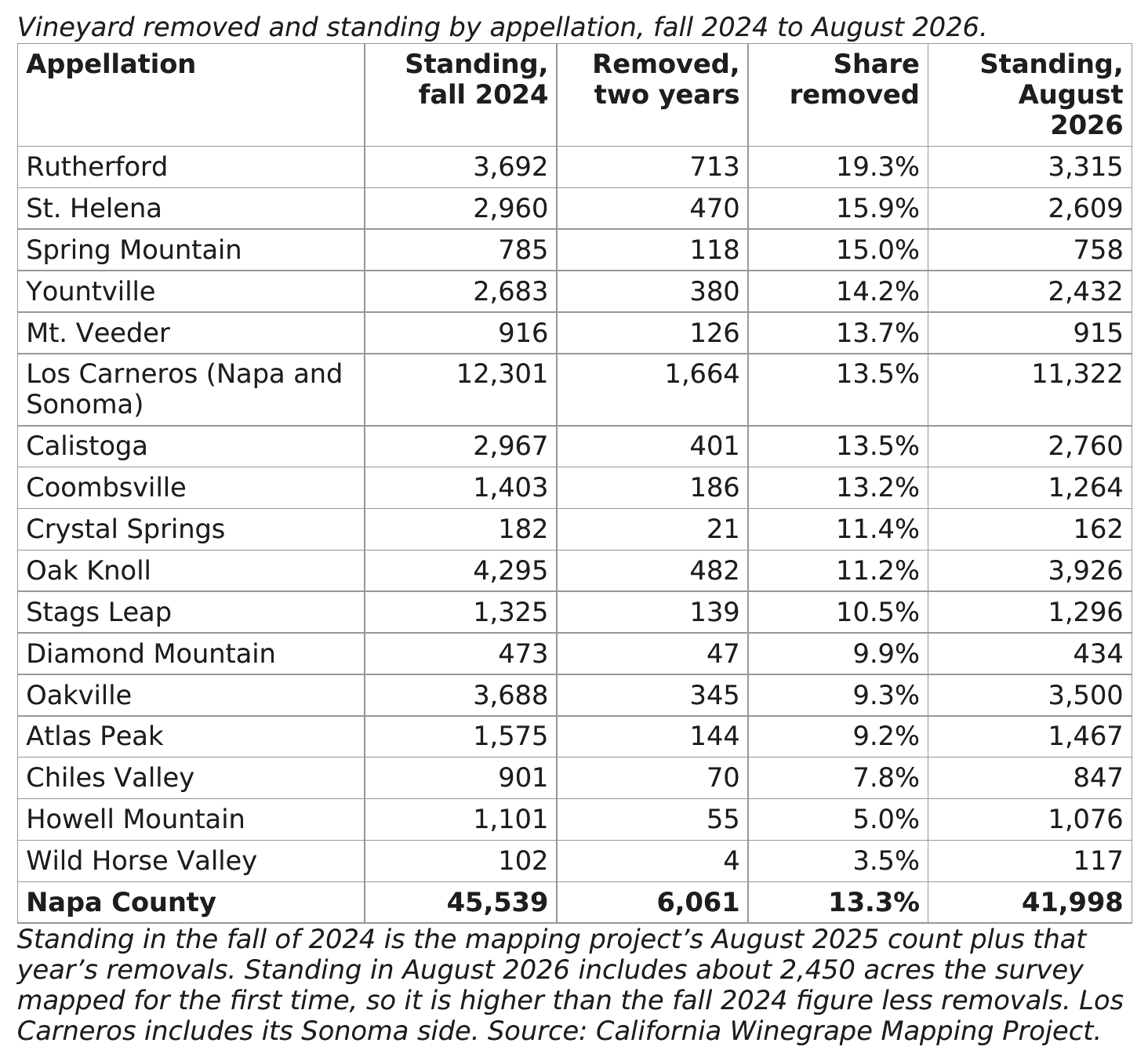
Carneros has lost more acres than any other district, about 1,660 on its Napa and Sonoma sides over two years, roughly one vine in seven. It grows mostly Chardonnay and Pinot Noir, and both are selling poorly. Ciatti reported last December that Pinot Noir demand remained disappointing and Chardonnay demand was more muted than expected. Good brands are still buying there. Chateau Montelena bought 73 acres last year to plant Chardonnay.
Some of the heaviest removals are on the valley’s best ground. Rutherford pulled about 19 percent of its vines in two years and St. Helena about 16, and some of that was pulled to replant, especially for red blotch, a virus that delays ripening and has spread through Napa’s vineyards.
But growers have replanted little. Across the county they planted about 640 acres in 2023, 420 in 2024, and fewer than 150 in 2025, so most of what has been pulled is leaving grapes, at least for now. Some growers leave a block fallow for a year or two before replanting, so a share of it may return. Replanting the 6,000 acres already pulled would take roughly $450 million to $600 million, at $75,000 to $100,000 an acre to prepare the ground, plant, trellis, and farm the young vines until they bear.
The pressure on the newer parts of the valley floor has not yet shown up in the removals. Coombsville and Oak Knoll were among the last parts of the valley planted, and many owners there bought near the top of the market to build brands that have not yet found enough customers. So far they have pulled vines at or below the county’s rate, but they carry the highest costs against the thinnest sales.
The hills are the surprise. Hillside vineyards cost the most to farm, up to $25,000 an acre a year for organic farming, against a county average of $14,000 to $16,000. Yet most hill districts have removed fewer vines than the valley as a whole, from about 5 percent on Howell Mountain to about 11 percent in Crystal Springs.
Pulling vines on a steep slope takes an engineered erosion control plan, a dry-season window, and money an owner under pressure may not have. Many hillside owners may be farming less, or not at all, and from the air a vineyard no one farms looks much like one that is farmed.
Meanwhile, investors are putting money back into the best mountain sites. The new owners of Spring Mountain Vineyard are replanting its roughly 225 acres, which is why that district shows heavy removals, and the Cain Vineyard’s new owners are replanting what the Glass Fire burned.
Who owns the land makes as much difference as where it lies. The most exposed are the owners who neither farm nor make wine. They hold about 16,000 acres, 39 percent of the county’s vineyard, and the analysis behind The Marginal Acre, an earlier essay in this series, suggests they could pull another 2,000 to 3,500 acres. Growers who farm their own land are far less exposed. Wineries are pulling their weakest blocks too, and Treasury Wine Estates has told investors it will shed vineyards in Napa.
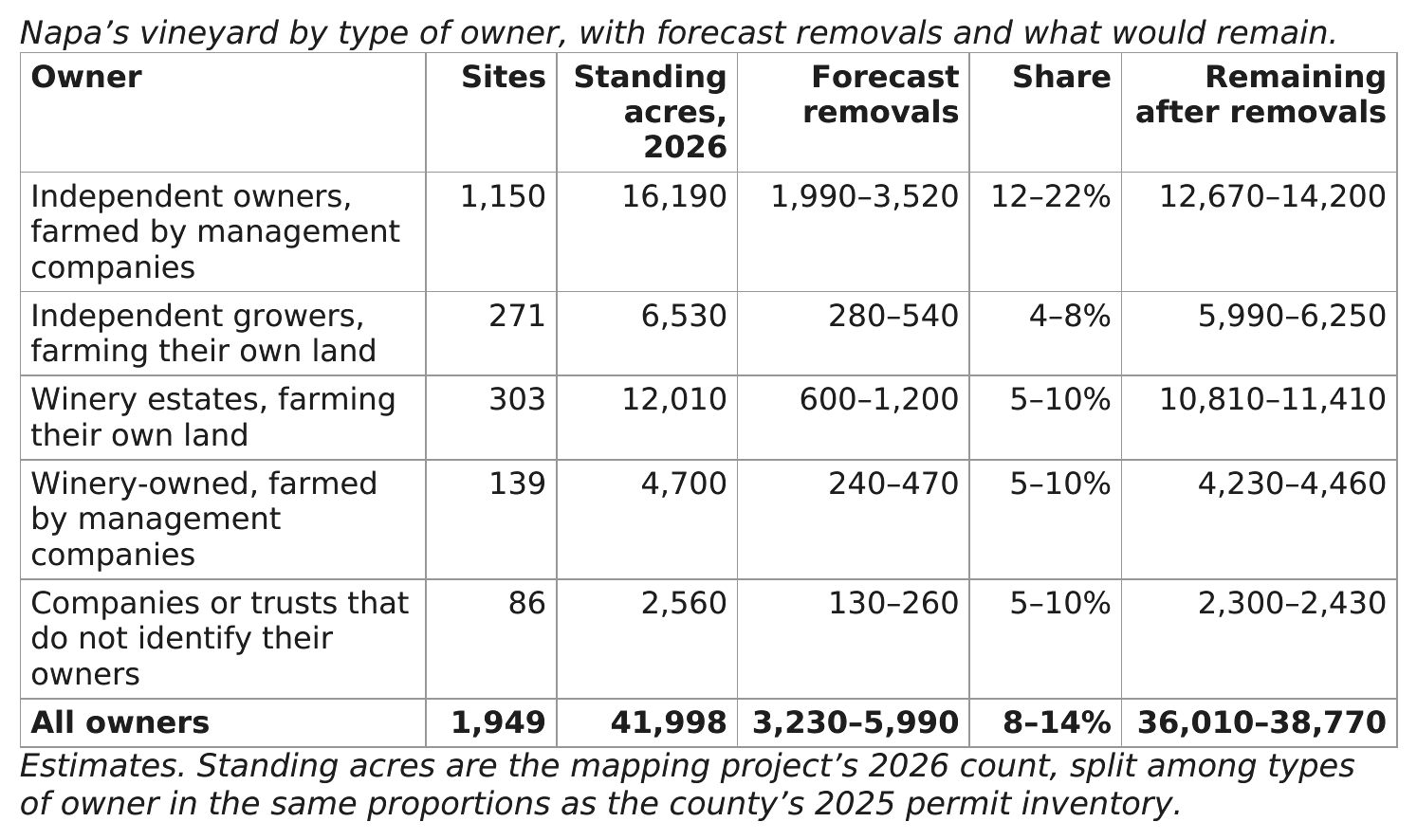
About 42,000 acres of vineyard stand today, by the mapping project’s count, which includes about 2,450 acres the 2026 survey mapped for the first time. If another 3,200 to 6,000 come out before the downturn ends, Napa will be left with roughly 36,000 to 38,800 acres. Counting what has already been pulled, the correction would take out a fifth to a quarter of the vineyard Napa had in 2024. Putting all of that land back into vines would take roughly $700 million to $1.2 billion.
The forecast comes from farming costs and ownership. It does not project demand for wine. It estimates which owners cannot keep farming at today’s grape prices, and it is most sensitive where vineyards are already close to breakeven. If prices fall further, removals will run toward the high end of the range, or past it.
On the floor and in the hills alike, owners and investors are sorting the land, backing the sites whose fruit has a home and leaving the rest. What that land becomes depends first on what else can grow there and whether there is a market for it.
Nothing Replaces Grapes
The county’s crop report answers the question of a replacement crop. In 2025, Napa’s winegrapes were worth roughly $970 million; everything else the county grew or raised came to about $5.5 million. Vegetables earned roughly $23,000 an acre on 23 acres, close to an acre of grapes, but local buyers will not take many more.
I know these numbers from the inside. Long Meadow Ranch grows most of the crops that are proposed as alternatives: vegetables, stone fruit, apples, citrus, olives, flowers, honey, eggs, and grass-fed beef and lamb. Measured by the county’s crop report, that is a meaningful share of what Napa grows besides grapes. By any standard outside Napa, it is very, very small.
What we have learned is that growing these crops is the easy part. Moving them to a genuine market is hard. A local food system needs cold storage, a distribution center, centralized ordering, and refrigerated delivery, and that system cannot be supported on Napa’s few thousand acres when the Salinas Valley, the Imperial Valley, and Mexico are a day away from California’s largest markets. The question is never whether a crop will grow here. It is whether it can be moved to a real market economically.
A few other Napa wineries are also multi-crop farmers. Clif Family’s produce supplies its food truck, preserves, and olive oil. Frog’s Leap makes jams, jellies, and preserves from what its gardens and orchards grow. Hudson Ranch in Carneros raises pigs, lambs, and chickens, presses olive oil, grows produce, and sells through its store at the Oxbow Public Market.
Those of us who grow these crops have each built our own systems. Our ranch sells through our high-traffic Farmstead restaurant and four farmers’ markets each week. Each system depends on a brand, a location, and customers that the wine business helped create, and none can be scaled to absorb thousands of acres. Olives, the alternative most often proposed, would make one more boutique product for the same small market, from orchards that take eight to ten years to reach full production.
The county once tried to build the market these crops would need. In 2010 the supervisors created the Local Food Advisory Council, with Agricultural Commissioner Dave Whitmer and Supervisor Diane Dillon behind it, and I was a founding member. Over more than a decade, we could never assemble the producers, distribution, and buyers a local food system requires. Growers needed buyers before they would plant, buyers needed volume before they would commit, and distributors needed both before they would invest. The council eventually expired.
I saw the same problem on a much larger scale. In the late 1980s, I led the work to restructure the Hawaiian sugar industry, through C&H Sugar, the cooperative owned by Hawaii’s sugar companies. Producers in Australia, the Philippines, and parts of the Caribbean made sugar at costs Hawaii’s plantations could never match, and after generations of family ownership the plantations’ managers acknowledged that sugar could not be sustained except in a few advantaged places.
The plantations searched for what their land could become, from pineapple and coffee to macadamia nuts, flowers, guava, and kiwi, but very few crops could be grown and sold at scale. In 1980, sugar and pineapple covered more than 300,000 acres in Hawaii. By 2017 they covered fewer than 5,000.
In the end, the use that paid was hospitality and luxury housing on the best-located land. Much of the rest was abandoned, and African grasses brought in as forage now cover nearly a quarter of Hawaii’s land. In August 2023, a fire, most likely sparked by power lines in high winds, ran through that grass above Lahaina and into the town, killing more than 100 people. There are small opportunities for new crops in Napa, and we should encourage them. But, realistically, no other commercial crops can replace vineyards.
Half-Farmed Land Is Not Neutral
Very few owners will walk away from a vineyard outright. The common risks are quieter: blocks farmed at the minimum while the owner waits, vines mothballed with little care, or ground pulled and left bare. Holding land while prices settle is a legitimate choice, and for some owners waiting is sound advice. But each of those quieter choices saves the owner money and may pass a cost to the neighbors.
California now treats neglect as a matter of law. Since January, AB 732 has let county agricultural commissioners fine the owner of a neglected vineyard that harbors pests up to $500 an acre, rising to $1,000 if the owner still fails to act. Keeping a vineyard alive with minimal farming runs about $5,000 to $7,000 an acre a year, so removal pays for itself within 14 to 17 months.
Red blotch makes the point sharper. The virus is found throughout the valley, on prime sites as well as marginal ones, and a minimally farmed block of infected vines is a standing reservoir of it, and the insect that spreads it, the three-cornered alfalfa hopper, feeds on more than 150 kinds of plants. Monica Cooper’s team at UC Cooperative Extension, the university’s farm advisers in the county, has caught more hoppers where vineyards border grassland or oak woodland. What one owner does with land taken out of grapes changes the risk for the vineyards around it.
The risk of fire is higher still. Since 2017, fires have burned about half of Napa County, most of it in the hills. A farmed vineyard, irrigated and mown, can slow a fire. A neglected one, with dry grass between the rows, carries it. The Napa name is a commons that every owner draws on. The physical valley is one as well. Pests, fire, water, and the look of the land all cross property lines.
What to Do This Season
Covering the Ground
The final decision of what comes next for a vineyard could take a few years. Some decisions should be made right now. A block pulled this year and left bare will be weeds by spring, and weeds beside working vineyards shelter the pests every grower is trying to control. Land coming out of grapes needs first to be kept covered and cared for while owners decide what it should become.
That job is cheap, and the season for it is now. Winter covers go in from mid-September into early November, so the seed germinates with the first rains. Seed and planting for a simple cereal cover cost tens of dollars an acre, a small fraction of the $75,000 to $100,000 it takes to replant an acre of vines. A winter cover holds soil through the rains, crowds out weeds, and builds organic matter.
Picking a cover crop is a great opportunity to take a constructive step now. Flowering mixes can feed bees, and Project Apis m.’s Seeds for Bees program supplies such mixes to California growers free. Where monarchs are the goal, native narrowleaf milkweed can be sown once the rains begin, in margins kept apart from grazing, since it is toxic to livestock.
Barley or oats can be grazed or cut for hay, and winter barley grown on fallow Napa ground has already been brewed into a truly local beer by Mad Fritz, the St. Helena brewery that malts Napa-grown barley.
But the mix has to be chosen with care. The hopper that spreads red blotch breeds mainly on legumes such as clovers, vetches, and bell beans, so beside working vines, covers without legumes are the safer choice.
None of this decides the land’s future. It keeps the future open. A block covered in barley, wildflowers, or native grasses this winter can be replanted, leased, sold, or restored next year. A block left to weeds becomes an erosion source in the heavy rains a strong El Niño winter can bring, its neighbors’ insect vector problem by spring, and a fire risk by summer.
Renegotiating the Contract
This time of year is also contract season. Renewal notices on evergreen contracts, which renew automatically unless one side gives notice, fall due now, and every one of them should be renegotiated.
Every contract up for renewal should also address red blotch. Testing is imperfect: samples taken early in the season or from young leaves often miss the virus, and a 2025 National Academies report raised concerns about the reliability of commercial laboratories. Taken from older tissue at harvest, though, current tests find nearly all infections. A contract can set the timing, the tissue, and the laboratory, and include a quality clause that runs for the life of the contract.
Growers have their own judgment to make. A grower who delivers fruit in October and waits months for payment is lending to the winery, and should judge the buyer as a lender would: does it have a distinctive brand that will plausibly succeed?
If not, the hard choices are better made now than after another season of farming for a buyer who may not last.
What the Land Can Become
Does the Fruit Have a Home?
Some of the most valuable fruit in Napa comes from the hills and some from the valley floor, and so does some of the least valuable. Location alone does not tell an owner which land should stay in grapes. For any block, the question is whether its fruit has a home, with a brand that reliably sells the wine.
By that measure, every block falls into one of three groups. Proven sites already sell distinctive fruit to brands that sell through. They should stay in vines, and their owners’ task is to protect that connection. Sites with real potential but no reliable buyer are where growers, wineries, and brokers should concentrate, connecting good fruit with successful brands that need it.
Marginal sites, unproven or very costly to farm, are the ones that should come out, especially if the vineyard is Cabernet. A few may be better suited to another varietal, but that change requires new investment, time, and a committed buyer. What those marginal acres can become depends on where the land lies and who owns it.
An owner can read from prices how much room there is. Cash costs are what an owner pays out each year to farm: labor, materials, harvest, property taxes, and insurance, before any return on the vines or the land.
On the valley floor, a 10-acre Cabernet vineyard has cash costs of about $4,100 a ton, against an average price of $8,645 in 2025, so prices would have to fall by about half before it stopped covering them. A 2-acre parcel could absorb a drop of about 40 percent. That makes losing the buyer the more immediate risk for floor Cabernet. The price per ton has much farther to fall before cash costs stop being covered.
Hillside Cabernet has almost no room at the county average. A 10-acre hillside block has cash costs of about $8,450 a ton, so it depends on the premium its fruit earns above that average. If the premium shrinks by 10 to 20 percent, many hillside blocks stop covering their cash costs. Merlot, Chardonnay, and Carneros Pinot Noir are already at or below cash breakeven, which helps explain the removals in Carneros.
Replanting is a different decision. An owner keeps farming existing vines as long as the fruit covers cash costs. A new block has to do more: it has to earn back the $75,000 to $100,000 an acre it takes to plant and bring into bearing. At the average price, floor Cabernet would still earn it back, but only for an owner confident that the fruit will have a buyer for the next 25 years. Few owners have that confidence today, one reason growers are replanting so little.
Making Choices on the Valley Floor
The floor is relatively easy to farm and once grew many crops besides grapes. It also holds the mistakes of the rush to luxury. Owners planted Cabernet even on poorly drained ground and heavy clay that do not ripen it properly. The economics seemed compelling. With a Napa appellation on the label, almost any Cabernet appeared to carry the value, and the price of the fruit outweighed questions about the site.
Only as buyers began to judge the wines on their actual quality did those marginal choices become apparent, and costly. Some of those sites could have grown excellent Sauvignon Blanc or Chenin Blanc. Instead, Napa’s Sauvignon Blanc crush fell from more than 18,000 tons in 2013 to about 9,300 in 2022 as growers replanted to Cabernet.
In the right places, Sauvignon Blanc might make sense, but it is not the universal solution. A well-sited block yields 8 to 10 high-quality tons an acre, against a county Cabernet average of about 3.3, so an acre can earn nearly as much as Cabernet, and the wine reaches the market within six months, with far less working capital tied up. It still competes in a crowded market of white wines and needs a brand and a plan to win customers. Chenin Blanc probably works the same way, in a far smaller market.
The answer also depends on the owner’s history. A family that has owned its land for generations, with no mortgage behind it, can farm Sauvignon Blanc profitably. A winery owner who paid $300,000 an acre a decade ago needs both the vineyard and winery margin to cover the purchase price as well, and at today’s prices no alternative varietal will do that.
Some marginal blocks on the floor are worth more as habitat than as vineyard, depending on where they lie. A block along the Napa River or one of its creeks can become a buffer that holds the banks, filters runoff, and gives wildlife a path between the Mayacamas and the Vaca Mountains.
Away from the creeks, the gain is for pollinators and birds. When UC researchers put nest boxes in 20 Napa vineyards, bluebirds and tree swallows moved in within a year, pest counts fell, and the birds ate the hopper that spreads red blotch. A hedgerow or a wildflower meadow on pulled ground helps the neighbors’ vines as well as the wildlife.
An owner who chooses habitat does not have to pay for it alone. The state’s Pollinator Habitat Program counts vineyard pulled within the last three years as eligible ground, and owners apply through the Napa County Resource Conservation District, known as the RCD, or the Land Trust.
Taking land out of vines does not always save water. By the county’s own guidelines, a vineyard on the valley floor uses 0.2 to 0.5 acre-foot an acre a year. Irrigated pasture and orchards use about 4 acre-feet, 8 to 20 times as much, and alfalfa more still. Land that comes out of vines and goes to a thirsty crop would draw more from the aquifer under the valley floor, not less.
Done well, the change could be large. Farms, homes, and wineries pumped about 16,600 acre-feet from that aquifer in the year ending last September, against the 15,000 the county considers sustainable, and agriculture, nearly all of it vineyards, accounted for about three-quarters of it. If vineyard irrigation falls with the vineyard, by a fifth to a quarter, pumping would drop by roughly 2,500 to 3,100 acre-feet a year, enough to bring it to about the sustainable level. Owners who replant would keep some of that water in use, so the saving would be slightly smaller. Wineries making less wine would save about 150 acre-feet more.
Resolving the Hillside Sites
Some hillside sites are highly valued. The ground is well drained, and the sunshine above the fog line and the wide swings in overnight temperature can make the vineyards among the best in the region. Others are poorly sited, unproven, and very expensive to farm because of terrain, remote location, and costly infrastructure.
As farmland, the hillsides were only ever suited to vines, orchards, and selective grazing. Wildfire risk, smoke taint, and the cost of insurance now stand in the way of new hillside planting, and they are leading some owners to reconsider the vineyards they have. Our home ranch in the Mayacamas shows what that means. It was planted to grapes and olives in 1872 and went out of production with Prohibition around 1920. No other crop took their place. Some sections were grazed, and the rest grew back to oak and brush for seven decades, until we began replanting on viable sites in 1990.
A marginal hillside block has three possible futures. One is to stay in vines for reasons beyond the fruit. During the Pickett Fire last year, crews used a Pope Valley vineyard itself as a firebreak, its irrigated vines and mowed grass helping to halt the fire, while helicopters dipped from nearby reservoirs. A block on a strategic ridge or above homes may be worth farming even when its fruit barely pays, because its value to the neighbors exceeds its value as a crop.
Another is a constructed firebreak, a strip cleared of fuel, or a grazed fuel break, where the vines come out but a line still has to hold. In some areas, native grasslands may support rotational grazing by cattle or goats beyond just a strip for a fuel break. We have been successful using cattle to graze on our ranch in the Mayacamas Mountains near Sugar Loaf Ridge.
The last is a return to oak woodland and chaparral. Oaks can regenerate naturally or be planted, but they cannot recover where livestock graze heavily, so land being rewilded has to be kept apart from land being grazed for fuel breaks or rotational pastures. A recent study found that the largest benefit of oak woodland restoration is reduced wildfire risk.
Some owners are already choosing that last path. Tom Clark and Laurie Claudon planted 16 acres of Cabernet on the back side of Howell Mountain and won critical acclaim on about 2,000 cases a year. This summer, retired, they told Wine-Searcher they are letting the vineyard return to nature. The fruit had a home, but the home was their own label, and when the family stepped back, the vineyard went with it.
Whatever becomes of the vines, the reservoirs, water tanks, and farm roads on a hillside ranch are community infrastructure because fire crews and first responders rely on it during wildfires and other emergencies. Napa Communities Firewise Foundation has invested in a program to map all of it and to make it readily accessible during an incident. Insurance and the neighbors give owners reason to keep it in service. California requires insurers that price wildfire risk to discount premiums for documented mitigation, and in Napa’s fire zones insurability itself can depend on it.
Relandscaping the Residential Parcels
On a small parcel where the house is most of the value, the vineyard was always partly landscape. Its owner, often someone who neither farms nor makes wine, has three realistic paths.
One is to keep the vines farmed at cost, leased to a neighboring grower or vineyard management company who has a buyer, and accept that the vineyard may earn little or nothing.
Another is to pull the vines and plant something easy to keep: a meadow, a hedgerow, or a small orchard for the household. Removal soon pays for itself, and public programs may help pay for habitat on recently pulled ground. Whatever replaces the vines should be chosen for water, too. Native plantings and careful landscaping use little; a lawn or a thirsty garden can use more than the vines did.
The last is to sell to someone who wants a home in the valley. The hard truth is that there are few other alternatives.
Protecting the Land for Good
For some owners on the floor or in the hills, the best answer is to protect the land permanently, and a conservation easement can be an elegant way to do it. Owners have granted the Land Trust of Napa County easements on about 96,000 acres, roughly 18 percent of the county, which it holds and monitors in perpetuity. Our ranch has granted five conservation easements.
An owner can deduct the value of the development rights given up by granting an easement, and the federal tax rules for qualifying farmers are generous. Most easements are donated. In rare cases a land trust buys the rights at fair market value; occasionally it buys them at a deep discount, and the owner deducts the difference.
The Agricultural Preserve and Measures J and P already restrict land use, so on the valley floor an easement mainly removes the right to build a winery or more homes. More important, an easement is permanent. Zoning can change: a future countywide vote could alter Measures J and P, and Measure P runs only until 2058. An easement keeps the land in agriculture, or another agreed use, even if the Preserve is altered.
Easements produce little or no direct cash. So, for an owner whose problem is debt, an easement can preserve the land’s character without solving the problem that brought the owner to the decision.
For a small-estate owner with more than one parcel, an easement can do more. Giving up the right to build on a second parcel can carry a large value, and the deduction can offset the cost of pulling its vines while the estate keeps its home. The deduction is worth something only to an owner with income to offset, and it requires a qualified appraisal.
What to plant on the old footprint is still undecided. The Land Trust, the RCD, and UC Cooperative Extension need to expand their support for these kinds of projects. A few examples have been implemented, including restorations of creek corridors, wetlands, and oak savannas, and plantings of native hedgerows and pollinator meadows.
Repurposing the Buildings
One of the biggest challenges is repurposing the winery and hospitality buildings constructed over the past twenty years.
The largest owners are already retiring buildings. Gallo, which acquired The Ranch winery in St. Helena with a crush capacity of 30,000 tons, announced its closure in February, and Treasury Wine Estates is consolidating production for Frank Family and Stags’ Leap at its St. Helena winery.
The 2015 committee saw this coming. One proposal, from a group of longtime growers and vintners, argued that brands making wine in other people’s wineries had reduced the need to build new ones in the Agricultural Preserve. Owners went on building anyway. Since 2006 the county has approved 130 new wineries, about 40 of them since the committee met, and as of last November another 56 had been approved but were not yet producing.
For the small family winery and many recent entrants, the building is harder to retire than the brand. Many facilities reflect their owners’ ambitions more than the needs of production, and their value may persist only as part of a private estate. Napa’s Luxury Squeeze proposed a bargain with the county: properties that voluntarily give up or sharply reduce their production and visitor permits might, under strict conditions, receive limited rights to lower-traffic uses.
Those alternative uses would likely be nonagricultural, such as small corporate meeting or retreat centers, artists’ workshops, recording studios, or classrooms and labs (perhaps for ag-related topics like plant science, animal husbandry or ecology). The conditions would be hard to define and enforce, but the uses would keep the buildings in use and help hold their value.
In April, the valley’s farm and wine organizations also proposed to the supervisors support for processing Napa-grown products other than wine, which could give a building a second use, and might expand the options for small-scale alternative crops.
The land is what families can pass to the next generation. Some long-standing families will sunset their own brand and find their strongest position as growers again, if their grapes are distinctive enough to sell to a strong brand.
Using the Help Already Available
Owners have more help than most of them know. An owner whose land has lost value can ask the county assessor to lower the assessment, and this year the assessor did so for 97 vineyard, winery, and hospitality parcels. Land under a Williamson Act contract, which lowers taxes on land kept in farming, is already assessed on its farm income, so the larger opportunity is on land outside the contracts and on parcels valued for a home site or a winery.
An owner with a farm loan has rights as well. American AgCredit, a leading farm lender in Napa, is a cooperative owned by its borrowers and part of the federal Farm Credit System. By law, a Farm Credit lender must consider restructuring a distressed farm loan before it forecloses, and must restructure when doing so would cost it no more than foreclosure. An owner who pulls and covers a failing block is in a stronger position to ask for time.
Add the state’s habitat money, the easement deduction, and the insurance discounts for documented fire mitigation, and an owner taking land out of grapes well has real offsets. Few owners know any of this exists.
The Land Will Become Something
Balance in the valley means vineyards growing fruit for wineries that can sell what they make, from vines healthy enough to make the wine the valley’s name promises. It also means that land whose grapes no longer have a home has a planned future: replanted to a varietal that has a buyer, restored to habitat along the creeks, kept as a firebreak, or returned to oak woodland on the hills.
Some of what the land becomes depends on problems no owner can solve alone. Red blotch, fire, water, and the cost of exit all cross property lines, and the next essay takes them up.
The land will become something either way. For each block, the open question is whether its owner decides now what comes next, or leaves it to neglect, distress, and time.
Sources, assumptions, and methodology for the vineyard-removal and water estimates are available here.
Next Week
What Owners Cannot Do Alone
The Missing Plan for Napa’s Acres Coming Out of Grapes
* * *
Ted Hall is a vintner and rancher at Long Meadow Ranch in Napa Valley. His winemaking career spans more than 50 years; he was named the 2017 Grower of the Year by the Napa Valley Grapegrowers and previously served as chairman of Robert Mondavi Corp. He writes about economics, incentives, and how complex systems shape real-world outcomes across diverse topics, including food, agriculture, wine, music, and baseball.
The experiences behind these essays are collected in a memoir of the same name, Tell the Truth and Do the Right Thing — lessons and stories from a life that has included McKinsey, Napa Valley, a Pacific crossing, and the Village Vanguard.
Thank you for your ongoing thoughts. They are helpful! We're returning some of the vineyard to oak woodlands and leasing acreage to a neighbor to plant ancient wheat, drilled after the first rains and requiring no irrigation. We need to do what we can to support winemakers and growers while also balancing with the local ecology and water resources. It will take a dedicated tribe to figure this out.
Thank you for writing this. It is a great read. I appreciate the blend of history, economics, and insightful commentary.