

What the Land Becomes Next was about the choices an owner makes for each vineyard block. This essay is about the problems no owner can solve alone: a virus that spreads from block to block, fire that runs from ranch to ranch, and an aquifer every well draws on. Owners are now facing another 3,200 to 6,000 acres coming out. Vineyard management companies could lose up to $115 million a year in billings, while up to 2,400 farmworker jobs could be lost. The wine industry has acted together before, and will now have to again.
In October 2009, Dave Whitmer, Napa’s agricultural commissioner, announced that the European grapevine moth and its larvae had turned up in a Chardonnay vineyard in Oakville. No one had ever found the moth in North America. The next year, traps across the county caught more than 100,000 male moths.
Our ranches were inside the quarantine, and we hung pheromone dispensers in our vineyards like everyone else. Whitmer was a force. His leadership was unrelenting, and he set the tone that made the program work: no one was accused of making a mistake or of starting the infestation. It was about finding a solution, not a culprit. That made it safe for everyone to get involved, and we all leaned in.
Whitmer could have managed the moth and taught growers to live with it. He set out to eradicate it. Growers, wineries, hobby vineyards, university scientists, and regulators at every level went after it together, mostly by flooding vineyards with pheromones so the moths could not find each other to mate. Seven years later, in 2016, the moth was declared gone. Eradicating an invasive pest once it has spread is almost unprecedented in the agricultural world.
Napa’s growers had done it before. In 2001, when the glassy-winged sharpshooter, an insect that carries a disease fatal to grapevines, threatened to move north, they worked with the county and the state on detection and then voted to tax themselves to go further. The Napa County Winegrape Pest and Disease Control District still collects $12 a year for every planted acre, and growers later voted to widen its work to vine mealybug and other pests.
The sharpshooter and the moth were beaten for the same reasons. The threat crossed property lines. A credible organizer led the work. No one was blamed, so everyone could take part. The cost was shared in a way that bound everyone who benefited, and public agencies were partners. The river restorations, from the Rutherford Reach to the work now under way on Bale Slough, rest on the same conditions.
Red blotch is the same kind of problem, larger and slower, and it will take the same approach: a shared fight, and no culprits.
Taking On Red Blotch Together
Red blotch is the largest of the shared problems, and no part of the valley is exempt from it, however valuable the site. It lowers quality, delays ripening, and drives much of the replanting the market now punishes. One owner cannot solve it alone. A clean replant beside an infected or neglected block is at risk from the start, because the hopper that spreads the virus moves across property lines.
The cost of a neighbor’s infection is real. UC Cooperative Extension in Napa modeled what red blotch costs a grower and found that removing and replanting an infected block works when the infected vines next door come out too, and works far less well when they do not. At last year’s Cabernet price, a block with one vine in ten infected loses about $1,450 an acre a year in fruit alone, before the cost of testing, pulling, and replacing vines. An owner who leaves infected vines standing avoids that cost and passes the risk across the fence.
The goal is to get the right vines out and to protect and replant the right ones, wherever they are. That means coordinated testing on a sound protocol, removing infected blocks neighborhood by neighborhood, clean planting stock, and attention to the margins and neglected ground where the hopper lives. Growers have good reasons not to want an infected block known. It can cost them contracts, land value, and reputation. As with the moth, the work goes faster when no one is blamed. It needs a trusted intermediary that holds test results in confidence and tells neighbors only what they need to coordinate, never an owner’s name.
The science is already under way. It can come from the GRBV Initiative, a research effort named for the grapevine red blotch virus. Industry funders launched it this year with $2.5 million in pledges, and The Virus We Planted described it. Its first research calls aim at earlier detection, practical mitigation, and a clearer understanding of how the virus spreads. The Napa Valley Grapegrowers, the growers’ trade association, is the natural organization to teach growers and spread best practice.
Growers have already formed neighborhood groups, on Pritchard Hill and in Rutherford, and in April the Grapegrowers brought neighbors together to manage red blotch block by block. The work now is to extend that across the valley.
Measuring the Gap
The same test applies to the other problems the current market correction creates, and each one fails the test somewhere. Thinning brush and forest across several ranches protects all of them, but each owner pays for the work on their own land. Napa Firewise organizes the work, mostly around neighborhoods and along roads, with owners who sign access agreements. Every well draws on the same aquifer, and the county’s groundwater agency organizes the pumping but has not yet tied its rewards to land kept out of vines. Along the river, owners could restore a common strip under one plan, as the Rutherford Reach owners did, but no one is bringing them together.
The 6,000 acres pulled since the fall of 2024 would cover about 9.5 square miles, roughly six times the size of Golden Gate Park, or a half-mile band along Highway 29 from Napa to St. Helena. The forecast adds another 3,200 to 6,000 acres, enough to carry that band past Calistoga. Every acre of it still has to be farmed, grazed, restored, or protected against fire by someone.
Most of the land coming out of grapes will stay out for years, and much of it for good. Replanting the 6,000 acres already pulled would take $450 million to $600 million. Counting the 3,200 to 6,000 acres still forecast to come out, putting it all back would total $700 million to $1.2 billion, at $75,000 to $100,000 an acre. Growers planted fewer than 150 acres last year. Thousands of acres of former vineyard will be part of the Napa Valley for a long time.
Against that much land, the work now under way is small, as the table shows for each piece of the shared work.
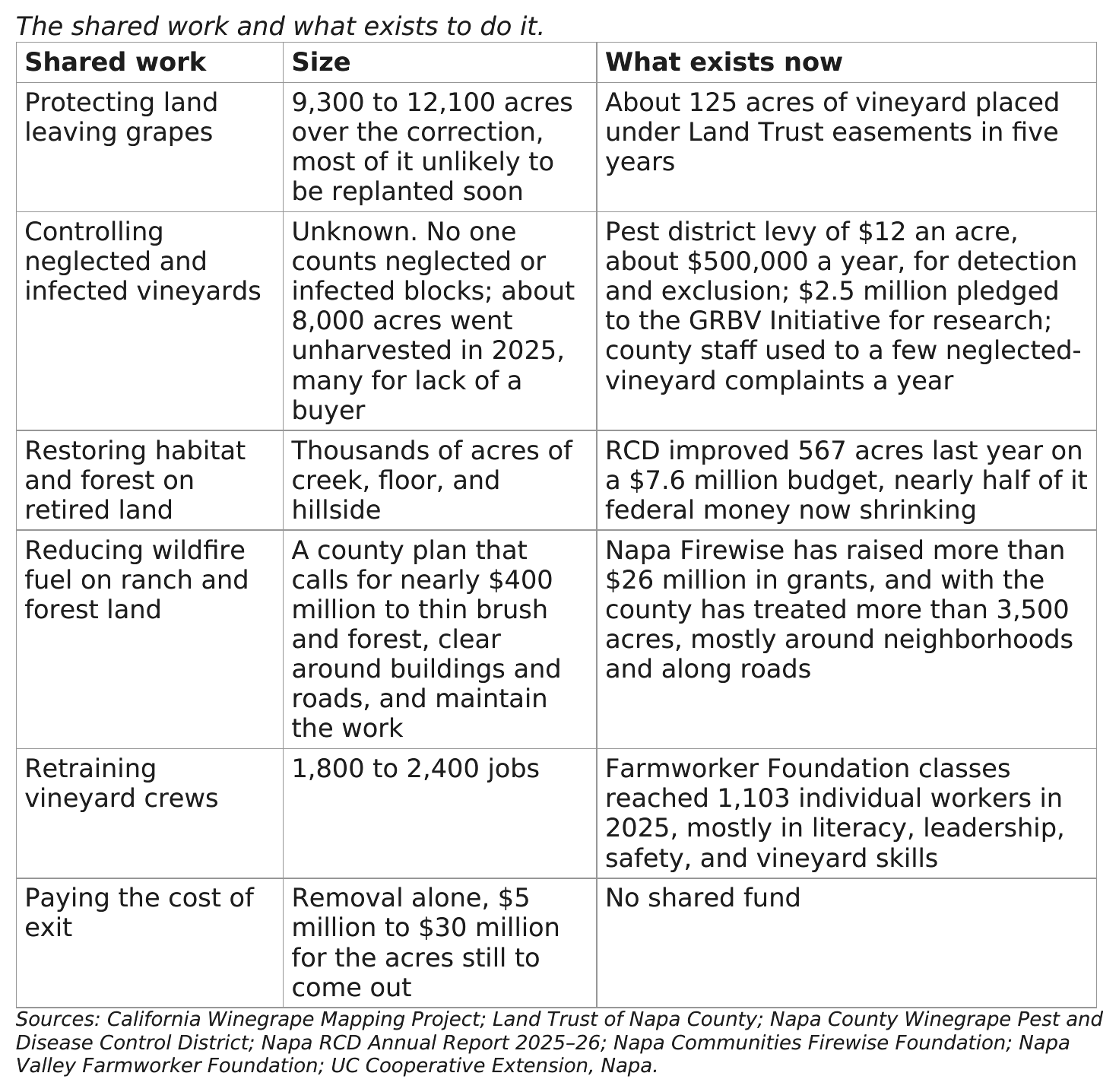
Down the table, the pattern is the same: each tool works at a fraction of the scale the correction requires. The Land Trust of Napa County protects land, but almost none of it is vineyard. The pest district taxes every planted acre, but its programs were not built for red blotch. The Napa County Resource Conservation District, known as the RCD, and the Napa Valley Farmworker Foundation reach hundreds of acres and many workers, but neither yet has a program built for land and crews leaving grapes.
Some of what exists is not being fully used. The RCD evaluates irrigation systems on about 20 vineyards a year and has the money to do 30. Its soil health advisers work with 10 to 15 growers a year and could work with 20 to 25. The county has about 1,950 vineyard sites.
The cost of exit is the hardest shared problem. Bordeaux offers one model. In 2023 the French government and the region’s wine council agreed to pay growers about €6,000 a hectare, roughly $2,600 an acre, to pull up about 9,500 hectares of vines, and growers applied faster than the money could cover.
The fund is possible because every Bordeaux producer must pay into the wine council. Paying the same rate on the 3,200 to 6,000 acres still likely to come out in Napa would cost $8 million to $16 million. Spread across Napa’s 42,000 acres over five years, that is $40 to $75 an acre a year, three to six times the pest district’s $12. Napa’s growers have shown, through the pest district, that they can bind themselves to share a cost. Whether they would do so for exit is hard to predict this early. The idea deserves debate, because without it each owner bears the cost of exit alone.
Managing the Workforce Transition
Taking land out of grapes will cost jobs, first at the vineyard management companies, which earn their fees farming blocks for owners who don’t farm and will contract as those blocks come out.
The work of a vineyard scales with its acreage, and so do the jobs of the crews who do it, whether they work for a management company, a grower, or a winery. The families who have done that work for generations will feel the correction more directly than almost any other owner.
By the county’s 2024 count, Napa’s vineyards employ about 9,000 farmworkers. If the work shrinks with the acreage, the full correction, including winery and corporate owners, could cost 1,800 to 2,400 jobs, a fifth to a quarter of the workforce. About 1,200 of the lost jobs are tied to vines already pulled. Owners who replant would lower that number only slightly, and the loss would be larger if the hillside blocks that need the most hand labor go first.
Napa’s vineyard management companies billed about $400 million in 2024 to farm the vineyards they managed, at an average of about $15,000 an acre across the floor and the hillsides, their fees included. They have already lost an estimated $50 million a year in billings from the vines pulled since then. The forecast would cost them another $35 million to $64 million a year. Together, that is a fifth to nearly a third of their business, or up to about $115 million annually.
Most of that loss has not yet worked through payrolls. Companies are only now realizing that the work is not coming back, and the layoffs are just starting. I know of at least one of the largest that is already cutting its full-time management staff. For the vineyard crews, the 1,800 to 2,400 jobs at risk come to roughly $65 million to $110 million a year in wages.
The same crews, equipment, and knowledge of the land are what the transition requires: pulling vines, seeding cover, thinning brush and forest, and restoring creek banks and hillsides. Much of the retraining will come from the companies that turn to that work.
The Farmworker Foundation already offers skills and safety training for vineyard workers, much of it in Spanish and during the workday, from equipment handling to pesticide certification. The RCD and UC Cooperative Extension know erosion control, habitat planting, and fuel management, and the Farmworker Foundation knows how to teach crews. Working with the companies, they could build the courses the transition needs.
Retooling for Exits and Repurposing
Napa’s institutions are built for entry and continuation. In April, the valley’s four main farm and wine organizations, the Farm Bureau, the Vintners, the Grapegrowers, and the Winegrowers, presented the county supervisors with 23 joint recommendations. All of them would let wineries compete more flexibly for the valley’s visitors, and with each other. None addressed how an owner might leave the business well, retire marginal acreage, or convert a building.
The public programs point the same way. The federal Tree Assistance Program helps pay to remove vines infected with red blotch or leafroll, but only if the grower replants grapes. Easement funding favors land threatened with development. An owner who wants to take land out of grapes responsibly will find rules that discourage the wrong outcomes and very little that supports the right ones.
The rest of the valley has as much at stake. The way owners take land out of grapes will shape what the valley looks like to the millions who visit, how well it resists fire, how much water its aquifer gives up, where its wildlife can move, and how many of its farmworkers keep their jobs.
The moth and the sharpshooter show what it takes for owners to act together. They have to trust the process. They have to share the costs and the benefits. Someone has to keep track of what is happening, year after year. And someone has to organize. Napa already has the organizations to do each of these.
Advising Owners and Keeping Count
An owner deciding whether to sell, lease, replant, or pull a vineyard needs a place to ask in confidence, without the question becoming news. It would have to be run by people bound to keep that confidence. Owners who do not farm need it most, and there are many of them: about 1,150 vineyard sites belong to owners who neither farm nor make wine, most of them under 10 acres. On parcels that small, everyone nearby has a stake in the answer. The Grapegrowers, UC Cooperative Extension, Napa Green, the RCD, and the Land Trust each hold part of the knowledge.
The same service could put promising sites in touch with brands that need their fruit, and put owners leaving grapes in touch with people who want land: young farmers hoping to grow vegetables or specialty fruit, and grazing operators looking for pasture.
Owners and the county also need to know whether any of this is working. Welcome, Six New Members proposed that the Vintners publish an annual count of the brands that arrive and leave. The land needs its own count. A simple yearly record from the Agricultural Commissioner of acres pulled, left fallow, planted to something else, or restored, reported by district and never by parcel, would show whether land coming out of grapes is being looked after or quietly neglected.
Giving Owners Reasons to Act
The loss in land value already sits with owners, lenders, and buyers, and no program will make it up. Little new money is coming. What the county and the valley’s organizations can offer is reasons to take land out of grapes well and look after it: some that reward the right choice, some that make neglect costly, and some that appeal to what neighbors owe one another.
The previous essay described the help owners already have: lower assessments on land that has lost value, the state’s habitat money, the easement deduction, insurance discounts for fire mitigation, and the rights of farm borrowers.
The county could add rewards that cost it little: simpler permits, waived fees, and quick review for owners who retire blocks to habitat or clear them of wildfire fuel. Its plan to cut groundwater pumping already considers rewarding landowners who delay replanting vineyards, an idea that could extend to land kept out of vines for good. Restored habitat could also supply some of the offsite mitigation the industry has asked the county to allow.
Doing nothing has its own costs, and they are rising. Fines under AB 732, the new state law against neglected vineyards that harbor pests, are one. Lenders and buyers discount land left half-farmed, and a vineyard that has slid into neglect is harder to sell, lease, or bring back. A red blotch clause in a grape contract puts a price on an infected block.
Enforcement will have to grow just as fast. The county is used to handling a few neighbor complaints a year about a neglected vineyard. With thousands of acres now unfarmed or poorly mothballed, it will need ten times that effort or more, and I do not think the county has yet grasped how large the change has been. That does not conflict with confidential testing for red blotch. An owner who finds an infection and helps control it deserves privacy; an owner who leaves a block to harbor pests for the neighbors does not.
Rewards and penalties will move some owners. Many will act for a simpler reason: neighbors notice who looks after the land and who leaves a problem across the fence.
A call to action works best when people can see the result. Million Trees Napa was started by vintner Tom Gamble with the RCD. It gave residents a way to act on forest health and has planted hundreds of trees, with native oaks a priority. A similar effort for bees, monarchs, and birds could do the same for land coming out of grapes. Start with a few willing owners, a small group of enthusiastic volunteers, existing state money, and a Saturday seed day in the fall. It could give the vineyard transition a very positive public face.
Restoring and Protecting Retired Land
Most of the work on land leaving grapes will draw on organizations that already do it. The RCD and UC Cooperative Extension, the university’s farm advisers, are the sources of expertise: what to plant on an old vineyard footprint, how to restore a creek bank or an oak woodland, and how to keep wildfire fuel down. The RCD can also help owners and neighbors win the grants that pay for much of the work. Napa Firewise raises the money and organizes the crews to reduce wildfire fuel: thinning brush and forest understory, clearing around buildings and roads, and grazing with sheep and goats.
The RCD’s executive director, Lucas Patzek, wrote in its latest annual report that fallowing vineyard land gives the district a real opportunity to restore native habitat. The district’s engineers point to one more use for retired ground: ponds that recharge the aquifer and hold water for fighting fire, which some grants will help pay for. Napa Green has $2 million from the National Association of Conservation Districts to pay Napa farmers who adopt regenerative practices.
On the Bale Slough restoration project, now under way, the county’s Flood Control District oversees the construction and the RCD provides the expertise.
The Land Trust holds and monitors conservation easements in perpetuity. Buying vineyards at the scale of current removals would take far more money than it could raise. It does not need to. Owners donate most easements, so the Land Trust needs money only to draw up and execute the easements and then monitor them, a far easier sum to raise.
The conservation easement tool exists, but owners are not yet using it for land coming out of grapes. Over the last five years, the Land Trust completed seven conservation easements. Only two covered planted vineyard, about 125 acres, one in 2023 and one in 2024, and it completed none in 2025. In the two years since the fall of 2024, owners pulled about 6,000 acres of vines.
There is a model closer to home. Since 2012, Marin County has used public funds to protect farmland. The county uses a dedicated fund to match what the Marin Agricultural Land Trust, known as MALT, raises from donors to buy conservation easements. The county has put $22.9 million into farmland this way, and MALT has used it to protect more than 11,000 acres. Paying for an easement would also put cash in the hands of a Napa owner leaving grapes.
What is new across all of these needs is the scale. Each service organization would have to treat land coming out of grapes as part of its mission and grow to meet it, from single projects to whole stretches of creek or forest, and from occasional easements to a steady stream of them.
Working with Lenders
Lenders will decide how many owners sell in distress, and how fast. A forced sale sets a low price for every neighbor, and a string of them can drag down values across a district. American AgCredit, a leading farm lender in Napa, is a cooperative owned by its borrowers, and as part of the federal Farm Credit System it must consider restructuring a distressed farm loan before it forecloses.
That gives lenders room to act in the valley’s interest as well as their own: extending terms while an owner pulls and fallows a failing block, valuing land at what it can now earn, and treating a block that is being looked after as better collateral than one left half-farmed. Banks outside the Farm Credit System are not bound the same way. They have the same interest in keeping the land that secures their loans looked after, and in avoiding a run of distressed sales.
Gaining Consensus on What It Will Take
This is not a master plan. It is a set of conditions and a few first steps from which a plan can come.
Most of this requires no new state law. It requires the valley’s organizations to make leaving the business, and the health of the vineyards that remain, part of their work. The county can count the land, simplify permits for owners who take land out of grapes and restore it, and reward owners through its groundwater plan. The GRBV Initiative can supply the science, and the Grapegrowers can carry it to every grower. The Land Trust, the RCD, and UC Cooperative Extension can turn retired ground into habitat and protected land.
Lenders can give owners time. And the trade organizations that wrote the April proposals can add the one they left out: how to leave the business well, and how to keep the vineyards that remain healthy enough to carry the valley’s name.
What it will take, above all, is leadership. The moth was beaten because Whitmer defined the problem, said so plainly, and kept everyone at it for seven years. Most of what this correction needs already exists: the research, the expertise, the easements, the grant money, the training. Today owners have to come and ask for it.
This correction may not need a single leader, but each of its parts needs one: someone to lead the work on red blotch, someone to organize the work of clearing wildfire fuel, someone to bring the owners along a creek together, someone to set up the confidential advice. The owners who need help most will find it nearly impossible to organize themselves, especially the small owners who neither farm nor make wine. Someone has to go to them.
Growers and vintners, the county, the RCD, the Land Trust, Extension, Napa Firewise, and the GRBV Initiative should begin by meeting in one room, and then again, in a series of seminars. The first would share what each organization knows and can offer. Later ones would agree on which problems come first and who will lead each one.
The convener should be neutral. The Napa Valley Community Foundation belongs to no industry group, and it has done this before: after the 2017 fires, it brought nonprofits and local government together to plan the recovery, and it built the network of more than 100 organizations that has coordinated the valley’s response to disaster ever since.
What Owners Can Do Together
In 1968, Napa’s vintners and growers supported the nation’s first Agricultural Preserve at a time when many landowners opposed it. They accepted a collective limit on what could be done with their land in exchange for a valley that would remain agricultural. The Preserve covers 31,609 acres, and no land has ever been removed from it. Four decades later, landowners along the Napa River gave up some of the most valuable vineyard in the world so that the river could function again, and their neighbors on Bale Slough are doing the same today.
Both decisions were collective, and both required owners to give up something of private value for a shared result. The decision now facing Napa’s owners and institutions is of the same kind. When the Agricultural Protection Advisory Committee met in 2015, the task was to protect farmland from the expansion of wineries.
The task now is to protect the same land from neglect, and to make it possible for owners to leave the winegrowing business without leaving the land worse than they found it.
The land will become something either way. Each owner can decide what one block becomes. No owner alone can keep the valley’s vines healthy, its water in the ground, its fires in check, or the next pest contained. Those outcomes are made together, or not at all.
Sources, assumptions, and methodology for the vineyard-removal, employment, and income estimates are available here.
Next Week
Keeping the Line Moving: “Base Hit, Ball Four!”
Two Small-Payroll Teams Found Value Other Clubs Overlooked
* * *
Ted Hall is a vintner and rancher at Long Meadow Ranch in Napa Valley. His winemaking career spans more than 50 years; he was named the 2017 Grower of the Year by the Napa Valley Grapegrowers and previously served as chairman of Robert Mondavi Corp. He writes about economics, incentives, and how complex systems shape real-world outcomes across diverse topics, including food, agriculture, wine, music, and baseball.
The experiences behind these essays are collected in a memoir of the same name, Tell the Truth and Do the Right Thing — lessons and stories from a life that has included McKinsey, Napa Valley, a Pacific crossing, and the Village Vanguard.
Ted, this is a terrific piece that tackles many complex issues in a reasoned fashion. Bravo! I’ll take this to my fellow board members of the Howell Mountain Vintners and Growers to get the collective red blotch response rolling there before we get a unified response from the entire valley. Well done and thank you.
'No one was blamed, so everyone could take part' is good advice well beyond vineyards, including churches and families. Do you think growers will rally around red blotch the way they did for the moth?