

Napa’s institutions welcome new wine brands with a ritual and let departures pass without notice. The valley needs something like 35 to 40 exits, mergers, or restructurings a year to return to balance. The Napa Valley Vintners has governed the Napa name as a shared commons better than almost any regional body in the world. The room in a consumer’s memory is shared too, but no published figure shows whether new brands are arriving faster than others are leaving.
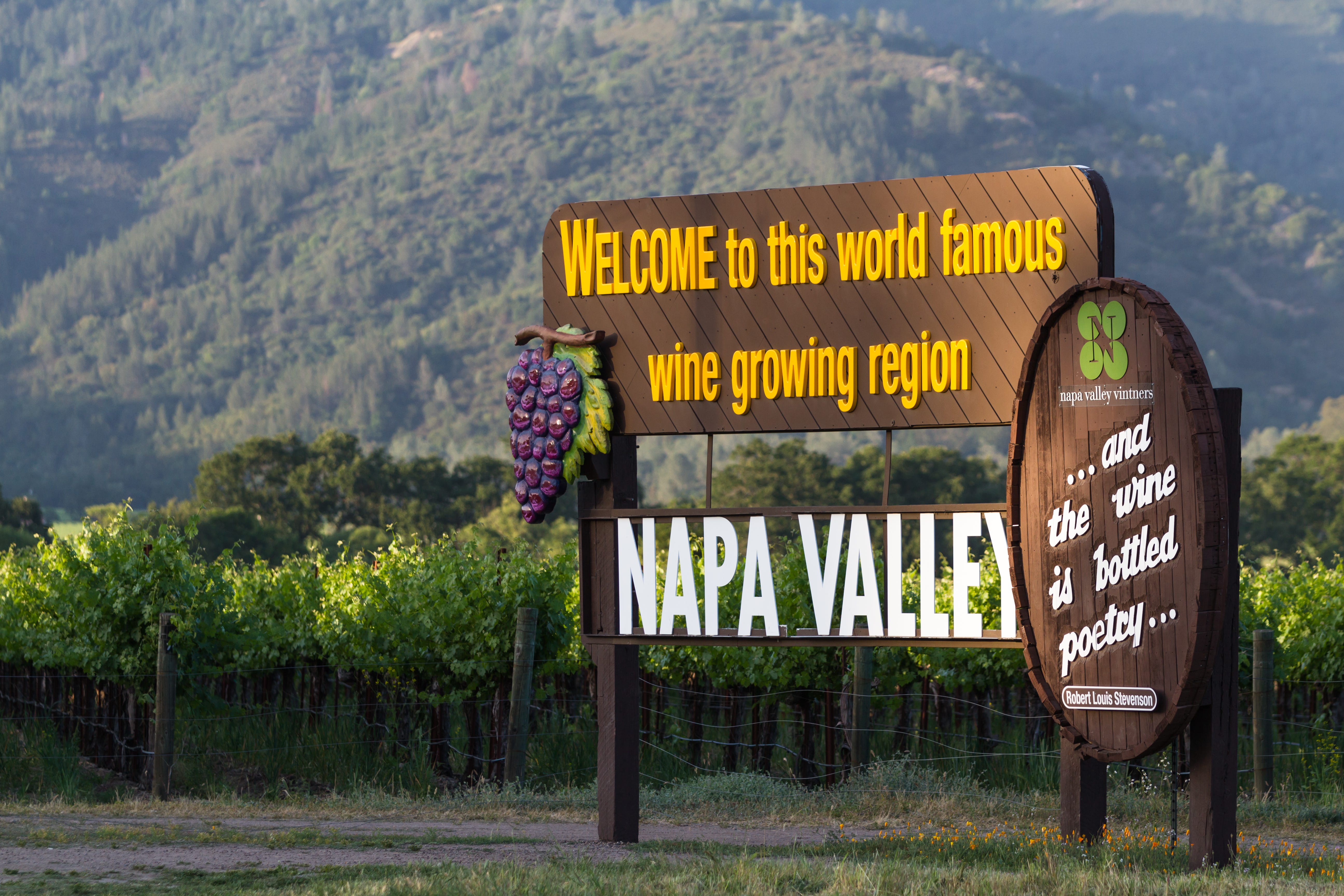
On a Friday morning in October, members of the Napa Valley Vintners opened a short, cheerful email. Beneath a photograph of the valley’s roadside sign, the one that welcomes travelers to “this world famous wine growing region,” the NVV asked its members to extend a warm welcome to six new wine brands joining its mission to “promote, protect and enhance the Napa Valley.”
Announcements like this one arrive regularly. The six names will not appear here because any recent welcome email could be used as an example. Every one of the newcomers joins the same Napa Valley brand that all of us share.
A Ritual of Arrival
From the beginning, the Napa Valley Vintners has given new members a hearty welcome. A new bonded winery may pass through a use-permit hearing, obtain its winegrower license, join the NVV, pour at its first trade tasting, and host its first release dinner. A brand made in a shared facility may skip some of those steps, but the social message is the same: it belongs. Like my fellow vintners, I have welcomed newcomers at Premiere Napa Valley and at the Auction Napa Valley festivities, and meant it.
The valley has no equivalent ritual for departure. When a winery winds down in an orderly way, as the owners named in Time to Get Real did, the news travels by word of mouth, if at all. When one fails, the evidence turns up in a license surrendered for unpaid fees, a vineyard listing, or a flash-sale site. Arrivals are announced to every member. Departures are left for each member to notice.
Organizations that need endings sometimes have to invent the ritual for them. My former partners, Bob Waterman and Tom Peters, later the authors of In Search of Excellence, worked on a project for Ore-Ida (then a subsidiary of H.J. Heinz), which they cited in their best-selling book. Ore-Ida’s product development laboratory rarely finished anything; once begun, a project carried on indefinitely in pursuit of its original objectives.
Part of the cure was a cannon, fired to celebrate what the company called a “perfect failure”: a project well conceived, honestly tried, and brought to an end. The cannon changed what an ending meant. Closing a project became an occasion everyone marked, and the people who closed it were free to start something with a better chance. Napa Valley has no cannon.
The Count
The departures no one marks are the ones the valley’s balance now requires. For two decades, investors financed more wineries and brands than consumers could support. Winegrower licenses in Napa County, one for each company making wine under its own federal permit, nearly doubled from about 1,000 in 2010 to 1,931 at their peak in June 2025, while producing vineyard acreage rose only about 6 percent from 2016 to 2024. Since that peak, the license count has fallen 4.5 percent. Licenses, brands, and acres measure different things. Taken together, they show the same land divided among more and more claimants.
Napa’s Luxury Squeeze estimated that of roughly 424 NVV members producing fewer than 10,000 cases a year, 100 to 170 are under serious economic pressure, and that restoring balance would take something like 35 to 40 exits, mergers, reversions, or major restructurings a year for three years.
The NVV email welcomed six new brands. A brand is not necessarily a new winery, a new license, or new capacity. Each one still adds another claim on consumer attention.
The people behind the new brands are doing something sensible from where they stand. An owner of good fruit sees margin in bottling it instead of selling it. A grower whose buyer has walked away has wine that needs a market. A founder who has succeeded elsewhere wants a label that carries the family name.
What keeps these decisions from being tested is time. A Napa brand needs seven to 10 years to receive a real market verdict. During that gestation, each entrant reads the welcomes of the others as confirmation, and acceptance, invitations, and the company of peers all arrive long before the reorders do. A brand welcomed this autumn will hear its own verdict early in the 2030s. The welcome email is the first of many signals telling it the decision was right.
What One More Name Costs Everyone Else
The sign in the welcome email’s photograph carries a second message, on the oval board beside it: Robert Louis Stevenson’s line that the wine is bottled poetry. It remains a fair description of what Napa Valley sells. By now, hundreds of brands make the same claim.
A new brand competes for something no one owns: a place in the consumer’s memory. Its fruit may be its own or bought, but that memory is common property. Few well-informed wine lovers could name 100 Napa wineries in 10 minutes, and most people who spend real money on Napa Cabernet would struggle to reach 30. Several hundred of Napa’s 500-plus wineries already sit outside even a knowledgeable consumer’s recall, and a consumer cannot ask for a wine whose name has not stuck.
Most Napa wineries are described in much the same language. Napa Valley’s Sea of Sameness distilled the self-descriptions of 512 wineries into a single prototypical description: a family-owned estate rooted in Napa Valley history, sustainably farmed, making small-lot Cabernet with passion. Only 54 of the 512 described themselves in ways statistically distinguishable from that prototype.
Look across recent arrivals and most have facts, histories, people, or circumstances no other brand can claim. But by the time their stories reach the consumer, those particulars have often been reduced to the same familiar language of family, heritage, small lots, and sustainability.
A new brand need not add a net new acre. Often, it creates another claim on fruit already being grown and, always, another name for consumers to sort. For wineries clustered near the collective Napa prototype, one more similar name slightly lowers the chance that any of them will be remembered, the newcomer included. The benefit of entry is private and immediate. The attention cost is spread thinly across everyone else.
An Institution Built for the Commons
If any institution in the valley is equipped to make that cost visible, it is the Napa Valley Vintners. Since seven vintners formalized the group in 1944, its members have repeatedly acted on problems no winery could solve alone: the Agricultural Preserve, protection of the Napa name in the United States and abroad, and more than $200 million raised through Auction Napa Valley for local health care and children’s education. Few regional trade groups anywhere can match that record.
That record is collective action at its most successful. Elinor Ostrom, who won the Nobel Prize for studying how communities manage shared resources without ruining them, found that successful commons share recognizable features, among them clear boundaries, rules suited to local conditions, monitoring of how the resource is used, and enforcement against misuse. For the commons of the Napa name, the Vintners supplies each of them. It helped write the rules on who may use the name, defends the name in court and in legislatures, and polices misuse around the world.
The Commons It Does Not Yet Measure
Napa’s wineries now depend on something else they share: the limited room in a consumer’s memory, and the limited demand for luxury Cabernet behind it. The Vintners cannot govern consumer attention the way it can police the Napa name. But the starting point is the same: it has to know what is happening.
Entry is recorded repeatedly, but in different units: county winery approvals, state winegrower licenses, and NVV member brands. Departures show up in surrendered licenses, consolidations, vineyard listings, and fruit left hanging. No published figure puts arrivals and departures side-by-side. Without that, no one can tell whether the number of brands is actually contracting or simply changing names and forms.
The NVV could publish a short annual State of the Napa Brand report, beginning with new brands, new producers where known, brands that exited or consolidated, and net brand change. Alongside county approvals and state license counts, the figures would let members see whether claims on consumer attention are being added faster than they are being removed. Such a report would serve the newest members most, because they are still deciding how large a bet to place.
The NVV’s position here is difficult. Its board is made up of vintners facing the same pressures as everyone else, and its budget depends on dues and on events that every member helps support. Membership organizations are built to help their members endure, and they find it easier to sponsor a seminar on direct-to-consumer marketing than a conversation about leaving the field with dignity. Publishing those counts would ask the NVV to show its own members figures many of them would prefer not to see.
The Vintners has faced harder choices before. Supporting the Agricultural Preserve meant accepting limits on what could be done with land across the valley, at a time when many landowners and farmers opposed it. The valley’s standing today rests partly on that willingness to accept a collective constraint for a collective gain.
An Honest Welcome
The six new brands were started by people drawn to what the valley has built, and the Vintners helped build much of it. A fuller welcome would keep its warmth and add what Napa’s vintners have learned at some expense: that a brand is remembered only if it can say something the collective Napa prototype does not, that consumers deliver their verdict years after the congratulations, and that departures deserve a count as careful and an occasion as honorable as those for arrivals.
The valley is famous, and its wine is bottled poetry. It now has more poets than readers can remember.
Next Week
What the Land Becomes Next
The Missing Plan for Napa’s Acres Coming Out of Grapes
* * *
Ted Hall is a vintner and rancher at Long Meadow Ranch in Napa Valley. His winemaking career spans more than 50 years; he was named the 2017 Grower of the Year by the Napa Valley Grapegrowers and previously served as chairman of Robert Mondavi Corp. He writes about economics, incentives, and how complex systems shape real-world outcomes across diverse topics, including food, agriculture, wine, music, and baseball.
The experiences behind these essays are collected in a memoir of the same name, Tell the Truth and Do the Right Thing — lessons and stories from a life that has included McKinsey, Napa Valley, a Pacific crossing, and the Village Vanguard.
It seems to me that we have developed a produce desert here — hard to name even 1/2 dozen Napa Valley growers of food, from the ground up — no pun intended. A few of us are out there scratching the dirt and growing some pretty amazing food. I see an abundance of diverse food crops being grown on the Sonoma side and I think we can learn from their creativity.
Grow Food NV
"...more poets than readers can remember..." True. True since the mid-1980s. But your analogy is insightful; it speaks to the hubris of those who believe they can do better than the people already here.