

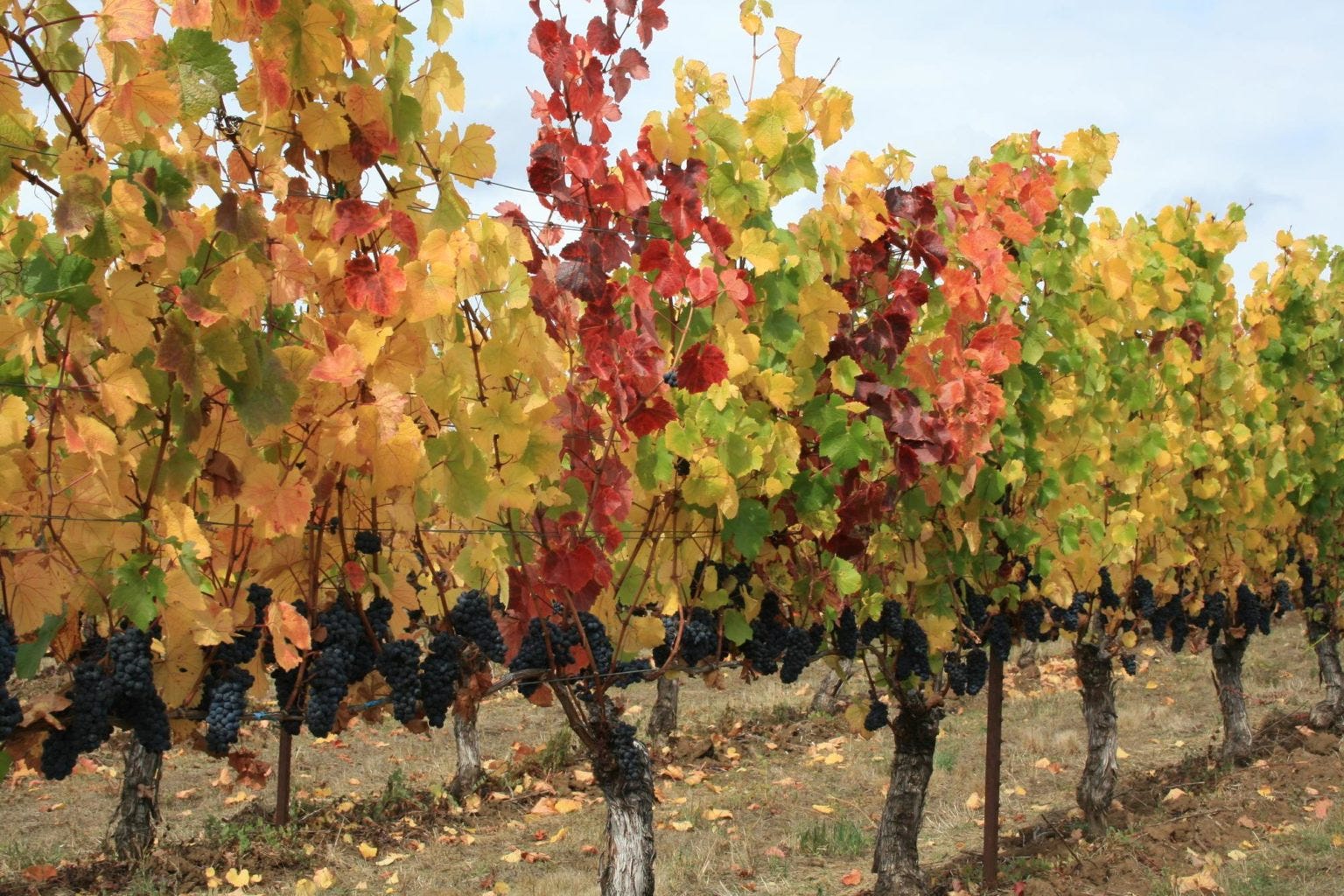
A market correction is already landing hardest on Napa’s smallest, most thinly capitalized growers. A second, unrelated shock is landing on the same acreage: a vineyard disease known as red blotch. The disease is spread partly through nursery stock and partly by an insect no fence can hold, with no cure and, unlike the phylloxera crisis before it, no permanent fix in sight.
I have walked vineyard rows in October for the better part of thirty-five years, reading the turn of the leaves the way every grower does: for color, for stress, for trouble. I could not tell you with certainty whether grapevine red blotch virus, a viral infection that quietly keeps an otherwise healthy-looking vine from ripening its fruit, is in a vineyard right now. That is not a comfortable thing for a grower to admit.
And not every red leaf means red blotch. Leafroll, nutrient deficiencies, trunk or root damage, and other stresses can produce similar symptoms.
Red blotch can sit in a vine for two or three seasons before a single leaf shows reddish to reddish-purple blotches and the telltale redness in its veins, which means the honest answer for most growers in this valley is less a confident no than an unconfirmed not yet. Nobody would know without testing for it, and until recently, almost nobody did.
First recognized in Napa Valley in 2008, red blotch has since been confirmed in vineyards across the United States and internationally. Brix measures the sugar building up in a grape as it ripens, and the virus can cut that number by five or six degrees, while suppressing the anthocyanins that give red wine its color and altering the tannins and other phenolics that affect its structure. The mechanism is reasonably well understood: the virus disrupts the hormonal signals that trigger ripening, so the vine never receives the full instruction to finish the job it started in the spring.
A National Academies review commissioned by the California Department of Food and Agriculture in 2025 described grapevine red blotch and its sister disease, leafroll, as threats to a wine and winegrape sector that contributes $73 billion a year to the state’s economy, made harder to manage by how long it takes winemaking itself to reveal the damage.
Agricultural economists have modeled the lifetime cost of a heavily infected vineyard running into the tens of thousands of dollars an acre. That number is large enough to ask, carefully, whether this is the most consequential vineyard health threat Napa Valley has faced since the phylloxera crisis of the 1980s and 1990s forced growers across Napa and Sonoma to replant most of their vineyards at enormous cost.
Marc Fuchs, the Cornell plant pathologist who has spent over a decade tracking a single Cabernet Franc vineyard in Rutherford, watched its infection rate climb from 3.9% in 2014 to 36.4% in 2023. That vineyard sits in Rutherford, widely described as the center of Napa’s outbreak; nobody has done the valley-wide survey that would show how far the pattern actually extends beyond it.
He originally suspected red blotch was moving in from a nearby riparian corridor, the strip of wild vegetation that lines a creek or stream, which would mean many separate introductions, each carrying its own distinct genetic signature. The genetic evidence did not support that theory: the virus in his vineyard was too uniform for that many independent arrivals.
What he found instead were two distinct epidemics running in the same vineyard at the same time: a slow, randomly scattered spread of about 1% a year in one section, and a fast, radiating spread of about 6% a year in another, a difference he traces to how densely the vector, the insect that carries the virus from vine to vine, had already established itself in each part of the vineyard block.
A Valley That Has Done This Before
California’s early winegrowers wanted high-quality grapes to build the nascent industry. European Vitis vinifera varietals produced the wines they valued, but the vines were vulnerable to a tiny root louse native to eastern North America and present in California by the 1860s. The insect was phylloxera. It feeds on grapevine roots until the vine can no longer sustain itself.
American grape species had evolved alongside phylloxera and could tolerate the damage; European vinifera could not. As it became established in California’s early vineyards, vines growing on their own vinifera roots began to die, threatening the developing industry.
The solution was to put the European vine on American roots. Growers grafted the fruit-bearing vinifera variety they wanted onto rootstock derived from resistant American grape species. The roots in the ground were one plant; the vine producing the grapes above them was another. The grower could keep Cabernet Sauvignon, Chardonnay, or whatever European variety was desired while protecting it with resistant roots below.
During the early decades of the twentieth century, breeders developed increasingly specialized rootstocks from resistant American species and their hybrids, cataloging thousands of crosses under alphanumeric breeding designations. Rootstocks such as 110R, 3309 and SO4 gave growers choices for different soils, vigor and growing conditions. With resistant American roots underneath European vines, the industry recovered and expanded.
In the 1960s, University of California researchers began recommending a higher-performing rootstock called AXR1. It was vigorous, easy to graft and widely suited to California vineyards, and growers across Napa and Sonoma planted it heavily through the 1970s. But AXR1 was different. It carried European Vitis vinifera ancestry as well as American ancestry. Researchers believed the American side of that parentage would provide enough resistance. For years, it appeared that they were right.
Then a phylloxera biotype emerged that could feed effectively on AXR1 roots. AXR1’s vinifera ancestry left it vulnerable to a strain its American parentage did not protect against. The first signs that something was wrong appeared in 1983, and for several years growers and vineyard managers treated the early symptoms as a curiosity rather than a crisis, since the vines were still producing fruit.
By 1989 the damage was severe enough that the University of California withdrew its recommendation of AXR1 altogether, three decades after endorsing it. Across Napa and Sonoma combined, an estimated 50,000 acres, 60 to 70% of the two counties’ vineyards, had to be pulled out and replanted onto phylloxera-resistant rootstock, growers splitting across Teleki 5C, 110R, St. George, and others, depending on soil and variety, at a cost at the time of $750 million to $1.25 billion. At today’s estimated replanting cost of about $75,000 an acre, replacing those 50,000 acres would cost roughly $3.75 billion.
Growers without the capital to replant sold to those who did. The ownership map that resulted is still visible today.
No Room to Wait
Phylloxera took years to reveal its full extent, because a vine does not announce a physiological problem the day it begins: it announces it only once accumulated stress crosses some threshold, vintage by vintage. Red blotch is following the same slow clock, still climbing toward whatever threshold it will eventually cross. Once visible, phylloxera forced a remedy: pull the vine and start over, at a capital cost far larger than the quiet annual loss the underlying problem had been extracting all along.
But the resemblance has a limit. Phylloxera killed the vine outright, which forced a decision: a dead vine cannot be argued with. Red blotch works more slowly, degrading the vine’s performance at the one thing it has to do well without ever killing it outright. A grower staring at a dead vineyard has no choice; a grower staring at a vineyard that is merely two Brix behind and slightly short on tannin has every incentive to wait one more vintage, and then another, while the loss compounds quietly and red blotch keeps spreading.
That difference in kind shows up as a difference in scale, too. Phylloxera forced its remedy on tens of thousands of acres across the two counties within a decade, because a dying vine leaves no room to wait. Red blotch has forced action only block by block, one threshold crossing at a time, because waiting is exactly what a vine that is merely a little short on sugar and color allows. That could still change: nothing so far rules out red blotch eventually forcing the same valley-wide reckoning phylloxera did.
No Border to Defend
That delay gives the disease time to keep spreading, aided by an insect that is already everywhere it needs to be and that behaves in ways researchers are still working out. Fuchs told growers at the Napa Valley Grapegrowers’ Rootstock conference in 2024 that red blotch does not behave like any other vineyard disease growers have learned to manage, and that the usual comparisons to Pierce’s disease or leafroll simply do not hold.
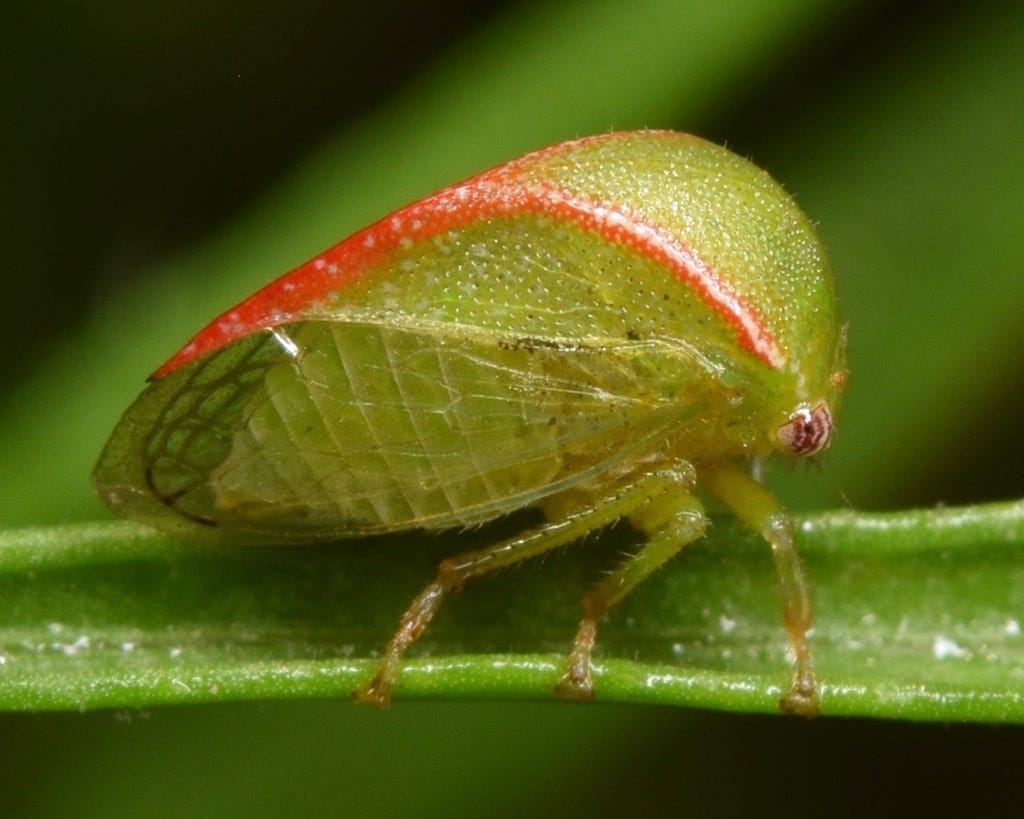
The three-cornered alfalfa hopper was identified as a vector years earlier, but its role as a vector in actual vineyards was only confirmed by researchers at Cornell and Clemson in 2023, and even then, transmission proved inefficient: most attempts to infect a healthy vine under controlled conditions failed. What compensates for that inefficiency is how common the insect already is, and how little it depends on the vineyard itself.
Victoria Hoyle and her collaborators, analyzing the gut contents of hoppers caught at 71 Napa vineyard sites, found them feeding on 171 different plant genera across 60 families, the great majority of them growing outside vineyards entirely: in ditches, dirt roads, riparian corridors, and untended woodland edges.
Researchers suspect the pattern tracks the weather: in dry years, with less food available in those margins, the hopper may move into the vineyard’s irrigated green rows to feed, while in wet years it can stay where it already has enough to eat. In the decade-long Rutherford study, precipitation three to four years earlier was significantly associated with epidemic behavior, although the biological mechanism is still being worked out. What a grower sees on the vine in any given October can reflect conditions from several seasons earlier.
There was never a discrete population to quarantine, the way California used inspection and quarantine to keep the glassy-winged sharpshooter, an invasive insect that spreads Pierce’s disease, a lethal bacterial pathogen, from becoming established in Napa and other non-infested areas. This vector was already living in Napa’s fields and hedgerows before anyone knew it mattered, and it will keep living there regardless of what happens inside any one vineyard’s fence line.
A Commons With No Fence
That makes containment a genuinely collective problem, not an individual one. Removing every infected vine on one property does little good if a neighboring block or an absentee-owned, unmaintained parcel keeps the virus alive in its own vines, while an unmanaged riparian edge keeps feeding the insect that carries it across a shared fence line. The tragedy of the commons already applies to Napa’s reputation, as The Commons We Forgot We Shared showed: a resource every producer draws on, and no one alone can protect.
Red blotch is the same structure, stripped of metaphor: an actual, biological commons, in which one owner’s neglect becomes every neighbor’s problem, regardless of how carefully the rest of the neighborhood behaves.
Monica Cooper, the University of California Cooperative Extension viticulture advisor for Napa County, said as much in her own closing remarks at that 2024 conference: vine-by-vine roguing, pulling only the vines that show symptoms each year, has not slowed the epidemic in blocks where the disease has already taken hold. Growers keep removing the symptomatic vines, and the infection rate keeps climbing anyway, because the neighboring vines that do not yet show symptoms are frequently infected already and will show it the following year.
The strategy Cooper and Fuchs both now recommend, zonal roguing, removes a diseased vine’s asymptomatic neighbors along with it, on the premise that vines standing next to an infected plant are the likeliest to already be carrying red blotch, whether or not they show it yet.
Elinor Ostrom, who won a Nobel Prize in economics for studying exactly this kind of problem, found that success in durable commons governance depends on clear boundaries, real monitoring, and some mechanism, even an informal one, for sanctioning free riders. Napa already has pieces of two of the three: boundaries and monitoring are not starting from zero. Growers created the Napa County Winegrape Pest and Disease Control District in 2002, in the scare over Pierce’s disease and the glassy-winged sharpshooter, and it still assesses every planted acre $12 a year to fund inspection, trapping, education, and University of California Cooperative Extension research.
As of 2025, part of that research is red blotch specifically. Cooper has reported to the district’s board on management strategies and sampling protocols, including the finding that an infected vine can take up to three years to identify, and that a hot spot can require pulling every vine within 30 feet of it, sometimes 60 in certain directions. At typical Napa spacing, roughly 1,500 vines to the acre, a 30-foot-radius pull already means removing on the order of 100 vines around a single hot spot; stretched to 60 feet in the direction the vector was moving, the count can run into several hundred.
The Napa Valley Grapegrowers have added a voluntary layer on top of that: the entire 2024 Rootstock conference devoted to red blotch, and a 2026 field day at Beckstoffer Vineyards built around neighbors coordinating removal across property lines.
Caleb Mosley, the Grapegrowers’ executive director, framed that field day in exactly the same terms: no single vineyard or organization was going to solve this on its own, and only the whole community working together stood a chance.
None of that, formal or voluntary, changes the calculation facing an individual owner. Pulling a vine that still looks healthy costs that owner money today, for a benefit that lands partly on the neighbors. The commons problem here was never about whether Napa could organize. It is about what happens when organizing still leaves the cost on one owner and spreads the payoff across the fence line.
The Marginal Acre, Again
The commons problem is sharpened by an asymmetry that The Marginal Acre already documented in detail: how Napa’s grape growers, and especially its smallest ones, meet every market shock with a different balance sheet than the wineries that buy their fruit: no inventory to borrow against, a single payday each November, and land often financed on the assumption of an uninterrupted fruit contract. Red blotch adds a second, unrelated shock to the same acreage already absorbing the market demand correction that essay described.
An estate that owns both the vineyard and the label absorbs both losses within the same business: a marked-down wine and a devalued vineyard remain with the same owner. A grower farming under contract to a winery is a different animal. Whether infected fruit triggers a price penalty depends on the buyer’s testing and the contract’s quality terms, while the capital cost of testing, roguing, or replanting falls on the grower regardless.
That cost falls hardest on exactly the parcels The Marginal Acre already identified as least equipped to absorb it. Vineyard management companies farm roughly 60% of Napa’s vineyard acreage on behalf of individual owners, spread across some 1,400 separate sites with a median size of just eight acres. The company farming the land is not the one that owns it, and a surprise cost like testing, roguing, or replanting is paid by the owner, not by the company hired to work the land.
The marginal acre was defined in The Marginal Acre as the last supply added in a rising market and the first eliminated when it falls. The same acre is vulnerable again because testing, zonal roguing, and replanting all require capital, and the acres already closest to the economic margin have the least room for another capital demand.
The Price of Looking
Testing, roguing, and replanting all share the same precondition: none of them work without knowing which vines are infected before they show it, and that is where the marginal acre’s disadvantage compounds again. Because red blotch can sit latent for two or three years, visual scouting alone catches only the fraction of infected vines that happen to be symptomatic in any given season. The rest remain infected but undetected until symptoms appear, giving the virus more time to spread.
Testing closes that gap, but testing costs money and, more than money, it comes with a learning curve. A standard laboratory PCR test through Foundation Plant Services, the University of California program that supplies nurseries statewide with their original clean planting material, runs $53 a sample. A newer field method, loop-mediated isothermal amplification, or LAMP, has brought that cost down considerably: Napa growers using it report $8 to $12 a sample, and the underlying research suggests the reagent cost alone can run under $2.
Monica Cooper, the same viticulture advisor who described zonal roguing above, and a coauthor of the Cornell-led economic study on red blotch’s cost, surveyed Napa growers using the LAMP assay and found that most do not feel confident running it until they have processed 50 to 150 samples themselves. That is a real fixed cost, paid in time and in early mistakes, before the technology pays for itself. A vineyard management company can spread that fixed cost across every block it manages; the owner of Napa’s median eight-acre parcel has only those eight acres to spread it across.
The Infection Arrived With the Vines
Everything so far has described how red blotch spreads once it is already in a vineyard: an insect moving between infected and healthy vines, a slow creep across a block. The National Academies review is direct that this is not usually how the disease reaches a new area in the first place. Propagation material is the predominant route, not the vector: the insect explains how an infection spreads once it exists, not where most infections come from. Fuchs’s own Rutherford vineyard, where the riparian-corridor hypothesis didn’t hold up, was already a case in point.
A comparative study of vineyards in California and New York found that the genetic diversity of red blotch in newly infected vines was far more limited than repeated, independent insect introductions would produce over the same span of years. What the researchers found instead looked like a single source, arriving once, at planting.
The virus itself is not new. Testing of archival plant material found it in a Sonoma County grapevine collected in 1940, which means it has likely been present in North Coast wine country for at least eighty years. What has changed is not the virus’s age but its visibility: for most of that history, nobody was looking for it, and for much of the last decade, even growers who were looking did not have an affordable way to find it before symptoms appeared.
The safeguard exists now, but it is newer and shakier than it sounds. California’s grapevine certification program dates to the 1950s, and only recently added red blotch to the list of pathogens it tests for. Even now, certified does not mean virus-negative. It means the material has met the program’s specified testing and propagation requirements, and those requirements can protect only against pathogens included in the protocol. The gap was an industry-wide blind spot, not any single nursery’s failure, which is exactly why so much material could carry the virus into the ground unnoticed.
Foundation Plant Services itself found red blotch in one of its foundation vineyards and ultimately built a $5.25 million insect-proof greenhouse to protect critical foundation material from red blotch and other insect-vectored pathogens.
Some of that risk is already in the ground. A vine’s working life runs 20 to 30 years, and Napa’s total vineyard acreage held remarkably steady, close to 45,000 to 46,000 acres, for more than a decade before the recent downturn, which only happens if a meaningful share of that acreage is replanted every year just to replace vines aging out. At that pace, something on the order of 15,000 to 20,000 acres has likely gone into the ground over the last ten years.
Every one of those replantings was a fresh chance for latent material to enter undetected. A block replanted three years ago could already be carrying the virus, waiting out its own latency before anyone has reason to look.
That undercuts a comfortable assumption: that a vineyard’s youth is evidence of its health. The vineyard a buyer or a lender would today treat as the cleanest collateral in a transaction, precisely because it was recently replanted, may in fact carry a defect nobody has priced, simply because nobody has looked, and because it has not yet had time to show itself.
What the Acre Is Worth
The Cornell-led research behind that lifetime-cost figure (Ricketts and coauthors, 2017; restated in the National Academies’ 2025 review of vineyard health) modeled costs across four wine regions and found a wide range: as little as $2,213 per hectare in eastern Washington, where initial infection was low and the price penalty modest, up to $68,548 per hectare, a little over two acres, in Napa County, where both the infection rate and the quality penalty were severe.
The study surveyed Cabernet Sauvignon vineyards in Napa and Sonoma alongside Merlot in eastern Washington and Long Island. Its highest modeled cost was in Napa, where both the assumed initial infection rate and the price penalty for suboptimal fruit were high. Restated in 2023 dollars, that put a Napa-specific lifetime cost near $34,000 an acre.
A comparable analysis of grapevine leafroll disease, red blotch’s better-known cousin and a virus with broadly similar effects on ripening and wine quality, used net present value to convert 25 years of future costs into a single number in today’s dollars. Without disease control, the modeled cost ranged from $10,000 to $17,000 an acre, depending on yield loss and the price penalty for poor fruit quality. Planting with certified, virus-tested material reduced the modeled disease-related loss to about $750 an acre, even after assuming a 25% premium for clean planting stock.
The red-blotch bioeconomic model behind the Napa lifetime-cost estimate, which weighs how fast the disease spreads against the cost of fighting it, puts a number on when to stop roguing individual vines and take out the whole block: once infection crosses 30%, replanting becomes the cheaper option.
The last phylloxera crisis ultimately forced the replanting of some 50,000 acres across Napa and Sonoma. No one knows how much Napa acreage red blotch will eventually force out, or whether it will ever approach that scale. But once infection reaches the point where entire blocks are cheaper to replace than to manage, the problem is no longer measured vine by vine. It becomes a capital event at vineyard scale.
Set that threshold against Napa vineyard values, which American AgCredit’s appraisal team currently estimates at roughly $50,000 an acre in outlying areas and $300,000 to $400,000 in prime Napa, with prime values at least 10% below the market’s recent peak. Even after that decline, a Rutherford block that crosses the replant threshold is not absorbing a modest agricultural setback; it is writing down capital at a scale that would be alarming on almost any other farmland in the country.
Replanting 15,000 to 20,000 acres at $75,000 an acre would require roughly $1.1 billion to $1.5 billion. That is not a forecast; it is the cost of replanting acreage comparable to what Napa has likely replanted over the past decade. Nor would certified plant material eliminate the risk of later infection by the alfalfa hopper.
Nowhere to Fall
The same virus is already established well beyond Napa: in Washington, Oregon, New York, California’s Central Coast and San Joaquin Valley, and internationally in Canada, Mexico, and South Korea. Published disease-cost estimates are nevertheless highest for Napa because of the market requirements its fruit has to meet.
Napa Cabernet has been priced for decades on the promise that it clears a high bar every vintage: full ripeness, deep color, real tannin structure. A lower market exists for Napa wine too, but it is a very long way down: Turrentine Brokerage’s March 2026 report put recent Napa Cabernet bulk-wine sales at $10 to $19 a gallon, a small fraction of what bottled Napa Cabernet sells for and nowhere close to covering what the land underneath it costs to carry. A block compromised by red blotch has nowhere real to fall: the tier that would take it does not pay for the ground it grows on.
Land compounds the same problem from the capital side. Napa real estate already carries among the highest per-acre values in American agriculture, so taking a compromised block out of production puts more capital at risk here than almost anywhere else growing wine grapes.
The larger question is what happens when this biological problem meets the economic correction already underway in Napa Valley. Napa Valley’s Reckoning described a market beginning to sort vineyards and wineries by their ability to survive lower demand, falling grape prices, excess capacity, and weaker balance sheets. Red blotch can change the pace and consequences of that reckoning.
A vineyard already close to the margin may now face testing, vine removal, or replanting at exactly the moment when its fruit contract, land value, and access to capital are under pressure. The consequences of those two forces acting together—for planted acreage, ownership, vineyard values, and the eventual shape of Napa Valley—are only beginning to come into view.
Napa’s unusually high economic exposure sits inside a biological problem that extends far beyond the valley. That reach strengthens the case for sustained research funding and has already drawn institutions well beyond Napa: Cornell, Clemson, and the University of California are all working on it.
A coordinated research effort is being organized now, with longtime Napa vintner Bart Araujo leading the industry effort and UC Davis’s Ben Montpetit helping shape its scientific development.
The Grapevine Red Blotch Virus (GRBV) Research Initiative is being structured as an industry-led, scientifically independent, multi-institutional collaboration. Founding funders have already pledged more than $2.4 million, with additional commitments under discussion, for research initially focused on earlier detection and practical mitigation, along with better understanding of the vectors, disease spread, and vineyard management practices that might slow transmission.

For growers, the immediate course is to plant certified material; test existing vineyards, including asymptomatic vines; remove infected vines according to the best current protocols; and stay close to the organizations coordinating the work. Napa Valley Grapegrowers, the Napa County Winegrape Pest and Disease Control District, University of California Cooperative Extension, and UC Davis are where new testing protocols, management practices, and research findings are being assembled and shared. Staying inside that information network gives growers the best chance to act before the disease announces itself.
Once a vine is infected, there is no cure; the National Academies review states that plainly. Roguing and replanting manage the disease by removing infected vines. The real question is whether the vine that replaces one can avoid becoming infected again, and that question splits in two.
Certified planting stock, the same safeguard already described as newer and shakier than it sounds, can substantially reduce the risk that the virus enters through planting material, and California’s grapevine certification program has begun addressing that pathway by adding red blotch to its testing protocols. The pathway through the vector is a harder problem. Roguing and other management can slow the spread, but nothing has ever closed it off, for the reasons already given: no quarantine, no rootstock, no genetic tolerance. The vector pathway has no fix in sight.
European grapevines arrived from outside the valley, and phylloxera killed them fast enough that no one could deny what had happened. Resistant American rootstock eventually provided a durable defense. Red blotch can arrive from outside the valley, carried in the planting material growers put into the ground, and it kills nothing. Vine by vine, vintage by vintage, what’s left behind is fruit that doesn’t pay for the ground it grows on. That can be slowed. It cannot yet be stopped: the insect cannot be quarantined, and grapevines have no known genetic resistance to the virus.
For Napa’s growers, the hardest part may be that important decisions now have to be made before we can know with any certainty how much disease is already there, how much of a vineyard must come out, or whether the vines planted in its place will stay clean.
Next Week
Outside the Frame
Why Rational Decisions So Often Produce Unexpected Results
* * *
Ted Hall is a vintner and rancher at Long Meadow Ranch in Napa Valley. His winemaking career spans more than 50 years; he was named the 2017 Grower of the Year by the Napa Valley Grapegrowers and previously served as chairman of Robert Mondavi Corp. He writes about economics, incentives, and how complex systems shape real-world outcomes across diverse topics, including food, agriculture, wine, music, and baseball.
The experiences behind these essays are collected in a memoir of the same name, Tell the Truth and Do the Right Thing — lessons and stories from a life that has included McKinsey, Napa Valley, a Pacific crossing, and the Village Vanguard.
You cannot deny that the Three-Cornered Alfalfa Hopper is a cute bug. Ted, your prior essays have laid bare the challenges Napa vintners have with supply-demand. Too many grapes chasing too few wine lovers. While its approach is largely random, maybe that little bug will help to reset supply. No master plan needed!
Oh boy, the problem of the commons and free riders. Milton Friedman would say you solve it via a tax levied by a growers' association on those growers in the zone, all of whom would benefit from the solution. This would relieve the burden on the smallest and most poorly capitalized entities. But first there must be a viable solution, probably developed by imposing that levy before there is any apparent damage. A tough nut.