
The Slide Rule
Five Hundred Years of the World’s Most Unholy Instrument

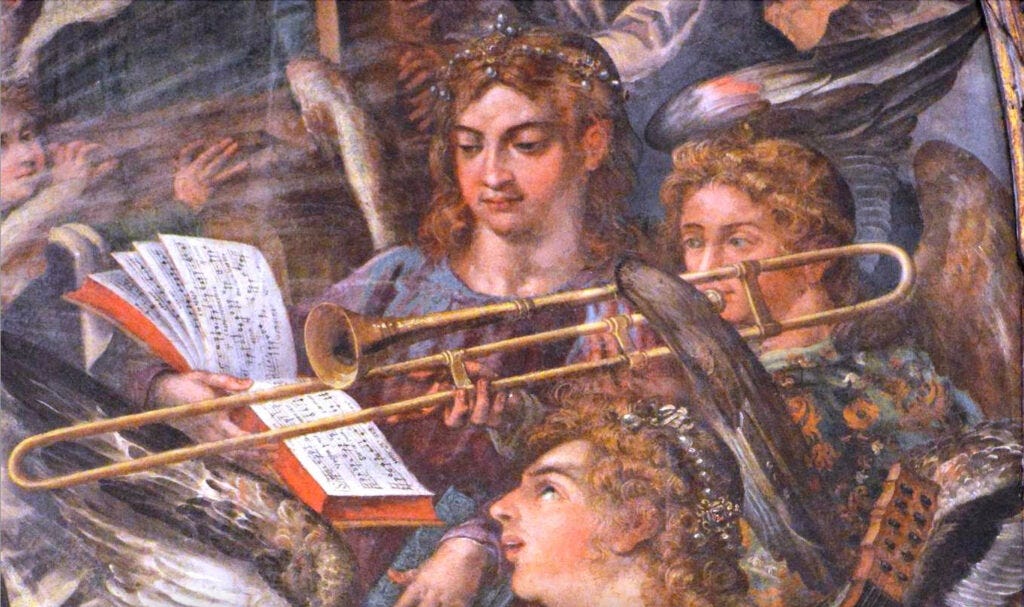
After multiple essays on wine, agriculture, and food systems, this week begins a fresh turn toward music—another field where romance, skill, tradition, incentives, and economic reality do not always line up neatly.
What is the difference between a dead squirrel in the road and a dead trombone player?
The squirrel might have been on his way to a gig.
It is a terrible joke, which is one reason it has lasted. It also gets at the central truth of the trombone: no instrument in music carries a wider gap between its dignity and its reputation.
For more than five hundred years, the trombone has been called the voice of God, the epic head of the wind family, the instrument of judgment, resurrection, solemnity, and triumph. Yet trombone players remain one of music’s most reliable punchlines.
I say this with affection. I am one of them.
This may seem, at first, like a departure from a newsletter about economics, incentives, and how complex systems shape real-world outcomes. But the range of this Substack has always been wide, and every subject I take on is anchored in firsthand experience. The common thread is not the topic. It is the way of looking: take something familiar, examine how it actually works, and try to tell the truth about it.
This week, that subject is the trombone.
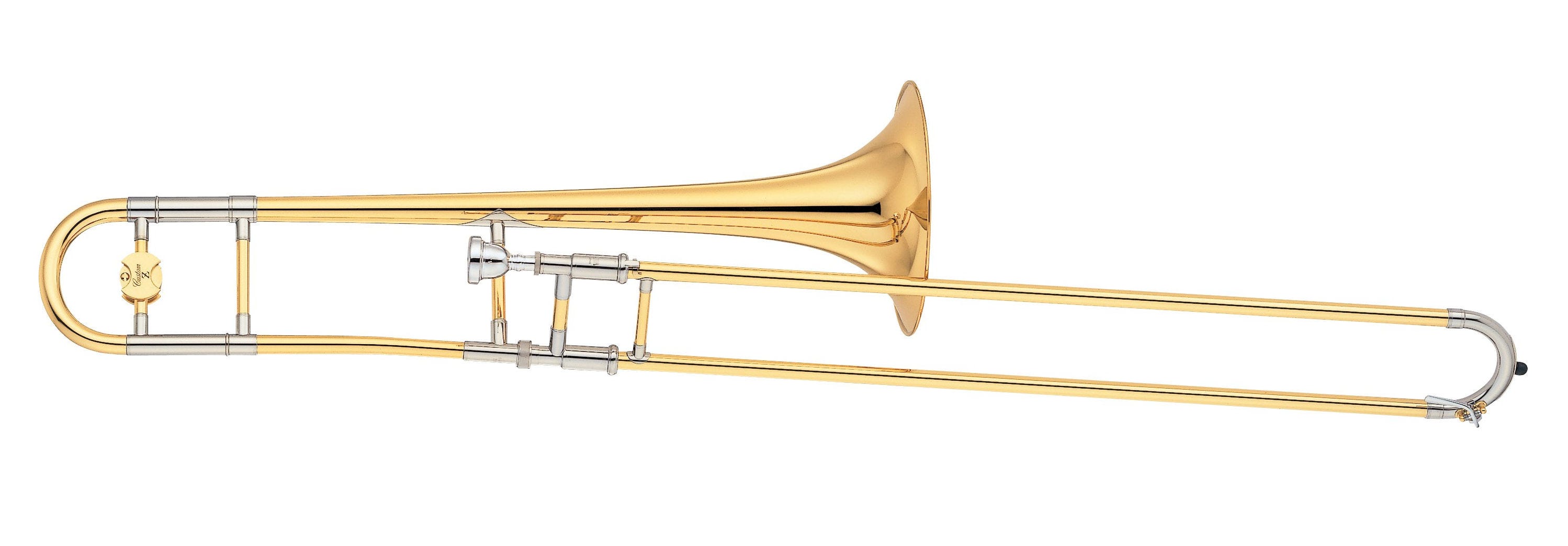
I have lived long enough with the instrument to know both sides of its character. Many years ago, I had the thrill of playing at the Village Vanguard. I still play now with a number of groups including the LMR Jazz Orchestra, at events such as the Timothy Hall Foundation Benefit Concert and in performances opening for Festival Napa Valley. So I have seen the trombone in a few of its natural habitats: jazz clubs, concert stages, vineyards, and joyous occasions where the music matters and the jokes somehow survive.
The contradiction is not incidental to the trombone. It is the trombone.
In every serious orchestra, dance band, brass section, or jazz ensemble, one or two musicians are usually sitting there with trombones, adding weight, warmth, bite, gravity, and, now and then, a glorious blatt. It may be the most useful and least understood instrument in music—which may help explain why it has also inspired so many jokes.
The trombone is one of the few instruments in Western music that seems to have arrived in the world essentially complete. Around the middle of the fifteenth century, probably somewhere in Burgundy or Belgium, an instrument maker took the natural trumpet and solved its greatest problem.
The trumpet had brilliance, but not freedom. Before valves were invented, it could play only a limited set of naturally (harmonically) available notes—not all the notes of a melody or scale. The trumpet was splendid for fanfares and ceremonial music, but unable to play a song.
The trombone could reach every note.
The solution was brilliantly simple: a double slide, lengthening and shortening the air column with a movement so logical that it has survived for centuries with almost no change in principle. Other instruments spent generations being improved, corrected, modernized, or rescued by technology. The trombone more or less walked in knowing what it was.
That may help explain the confidence of trombonists. We do not merely play an instrument. We play one of the great engineering solutions in music history.
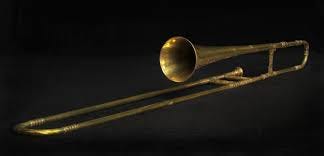
Even its early names had a kind of muscular honesty. The French called it the saqueboute, from verbs meaning to pull and to push. The Italians called it the trombone—simply, the large trumpet. Both are accurate. The instrument is at once practical and theatrical. It finds pitch not by pressing something down, but by physically reaching into space.
That is part of its charm. It is also part of its hazard.
In a big band, the saxophones sit in front of the trombones. So, one practical rule of life is simple: find the note, shape the phrase, and try not to hit the saxophone player.
For much of its early life, the trombone belonged to the church. The early “sackbut” (Anglicized from the French) could blend with voices in a way that still seems uncanny. It did not sit on top of a choir so much as enter into it. This is how it acquired that exalted reputation as the “voice of God.”
That phrase may sound grand until you hear trombones in a resonant building, supporting vocal lines with that grave, centered sound. Then it feels less like metaphor than observation. The instrument was valued not just for power, but for dignity—for its ability to add weight without losing clarity.
I experienced that character in a way I will never forget. As a young player, I performed on trombone in the Requiem Mass composed by Robert Lewin, for Robert F. Kennedy, broadcast nationally. To be part of that sound in a moment of such public grief and history left a lasting impression on me. It was a reminder that the trombone’s voice—solemn, human, and unadorned—still carries a weight few instruments can match.
And yet I have always liked another way of putting it. Someone once said that the trombone has the pitch and character of a human voice. The cello may be its closest rival. But among brass instruments, the trombone is unusually human. It can proclaim, plead, mutter, sigh, mock, and sing. It can be comic and solemn within the same phrase. A good trombone line does not just sound—it speaks.
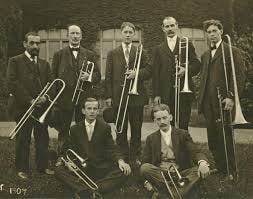
Its sacred role traveled. In Moravian communities in early America, trombone choirs announced deaths, summoned worshippers, and marked important events. They functioned almost like a musical public address system. There is even a frontier story—probably improved in the retelling—of a trombone choir frightening off attackers who mistook the sound for the voice of God.
Whether or not it happened exactly that way, the point stands.
For a long time, the trombone did not merely entertain. It signaled something larger.
Then it entered the orchestra and acquired another identity: the force withheld until needed.
Gluck and Mozart used it for the supernatural. But Beethoven changed its fate. In the Fifth Symphony, he holds the trombones back until the finale. When they arrive, the room changes. From that moment on, the instrument becomes a central orchestral voice.
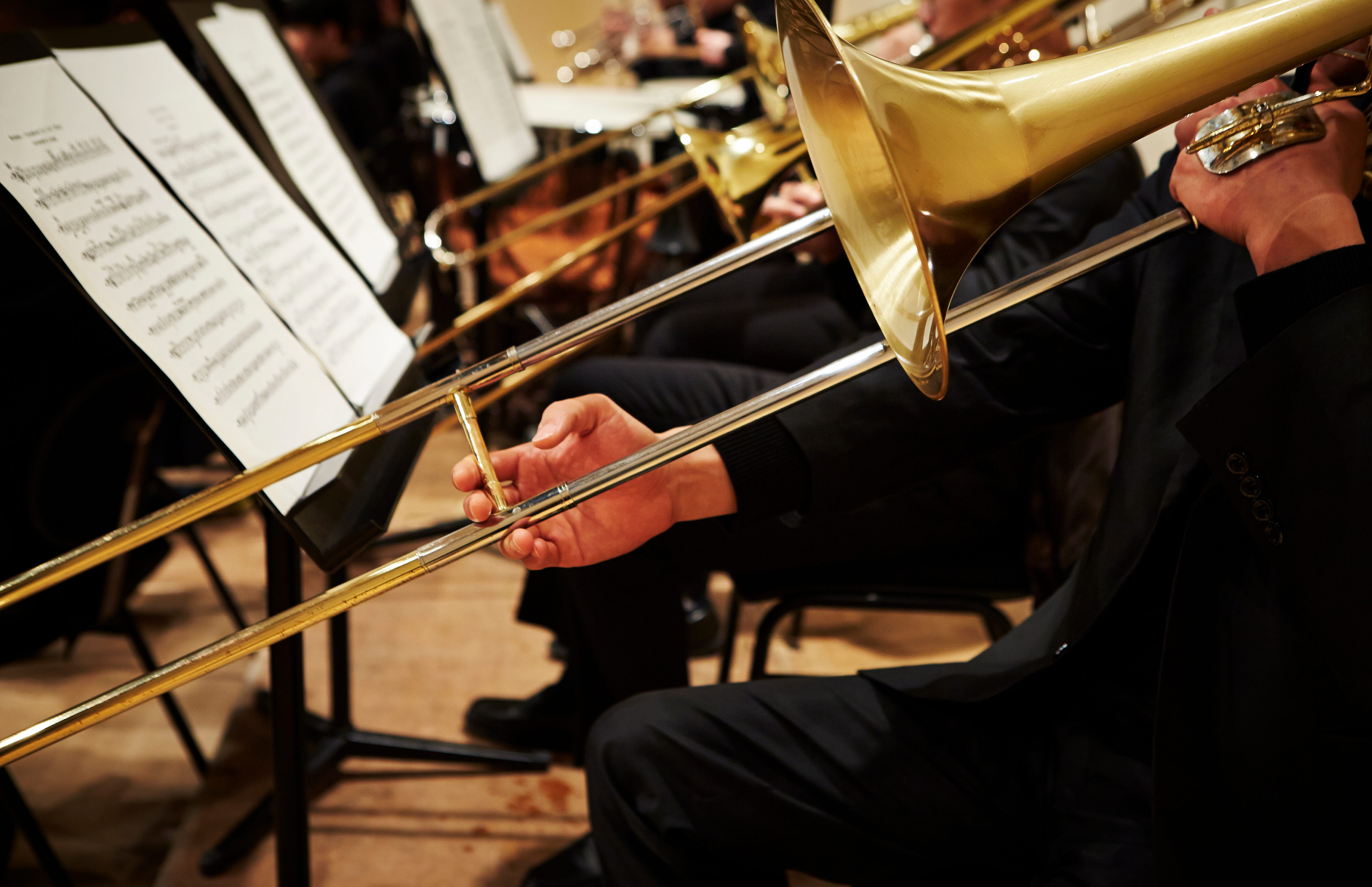
Beethoven understood something fundamental: the trombone is most powerful when it arrives with purpose.
Of course, he also helped define the life of the orchestral trombonist—counting rests. Pages of them. Minutes of stillness, followed by a few bars that must sound like fate.
The instrument also found a natural home in military and civic bands, where its power and clarity made it ideal for outdoor performance and ceremonial display. In that setting, the trombone became part of the public soundscape—marches, parades, and patriotic occasions. Its image even entered popular culture.
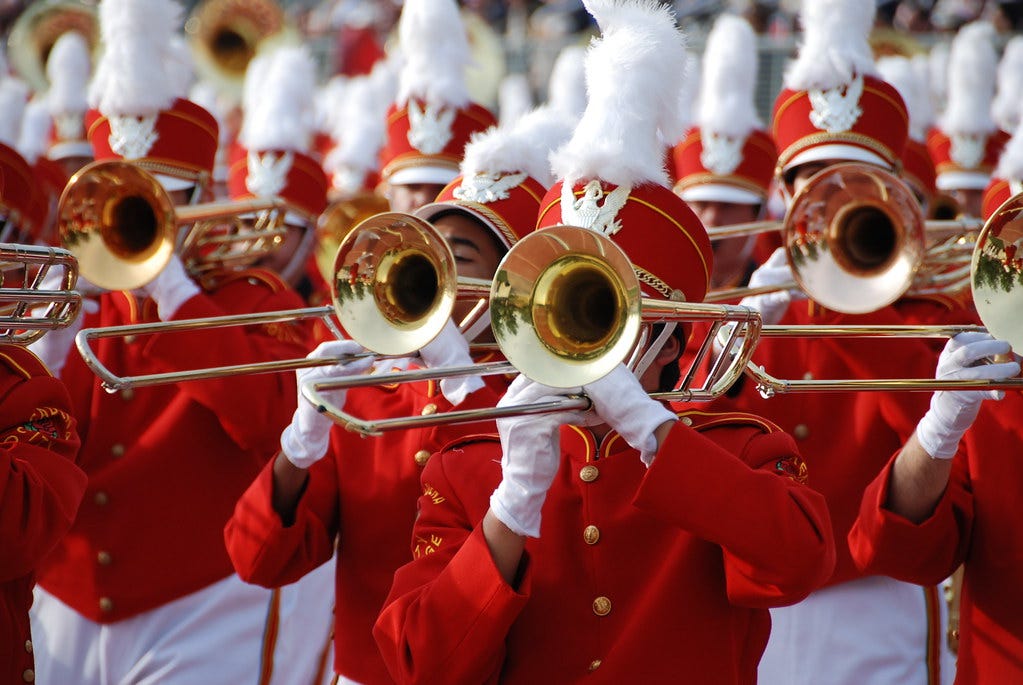
Meredith Willson’s “Seventy-Six Trombones” from The Music Man turned the instrument into a symbol of spectacle and American exuberance. It is hard to imagine a more exuberant vision of the trombone than that opening parade.
The trombone also thrived in film and television. Henry Mancini gave it swagger in themes like Peter Gunn, while John Williams drew repeatedly on the force of the low brass—trombones included—in scores such as Star Wars, Raiders of the Lost Ark, and Superman. By then, the instrument had become nearly impossible to miss—in churches, concert halls, marching bands, movie scores, and popular culture.
Which may explain the humor.
“Never look at the trombones; it only encourages them,” is commonly attributed to Richard Strauss. It survives because it is perfect: unfair, affectionate, and true.
Not everyone admired the instrument. Berlioz heard nobility. Mendelssohn thought it too sacred for frequent use. Mark Twain called it “unholy.”
The trombone has always lived between those extremes.
Trombonists have been unusually willing to collaborate in their own defamation. In some versions of that opening joke, there are tire skid marks only near the squirrel.
Then there is the classic: How do you know a trombone player is at your door? The doorbell drags (trombones are notoriously behind the beat). Another version puts the trombonist in a Domino’s Pizza hat.
What is the difference between a trombone and a chainsaw? The chainsaw is in tune.
And then there is the comparison with a certificate of deposit: over time the CD matures and starts earning money. The trombone player, presumably, does neither.
One of my favorites is closer to home. When I was a kid, I told my mother I wanted to be a trombone player when I grew up. She said, “Oh Teddy, you know you can’t do both.”
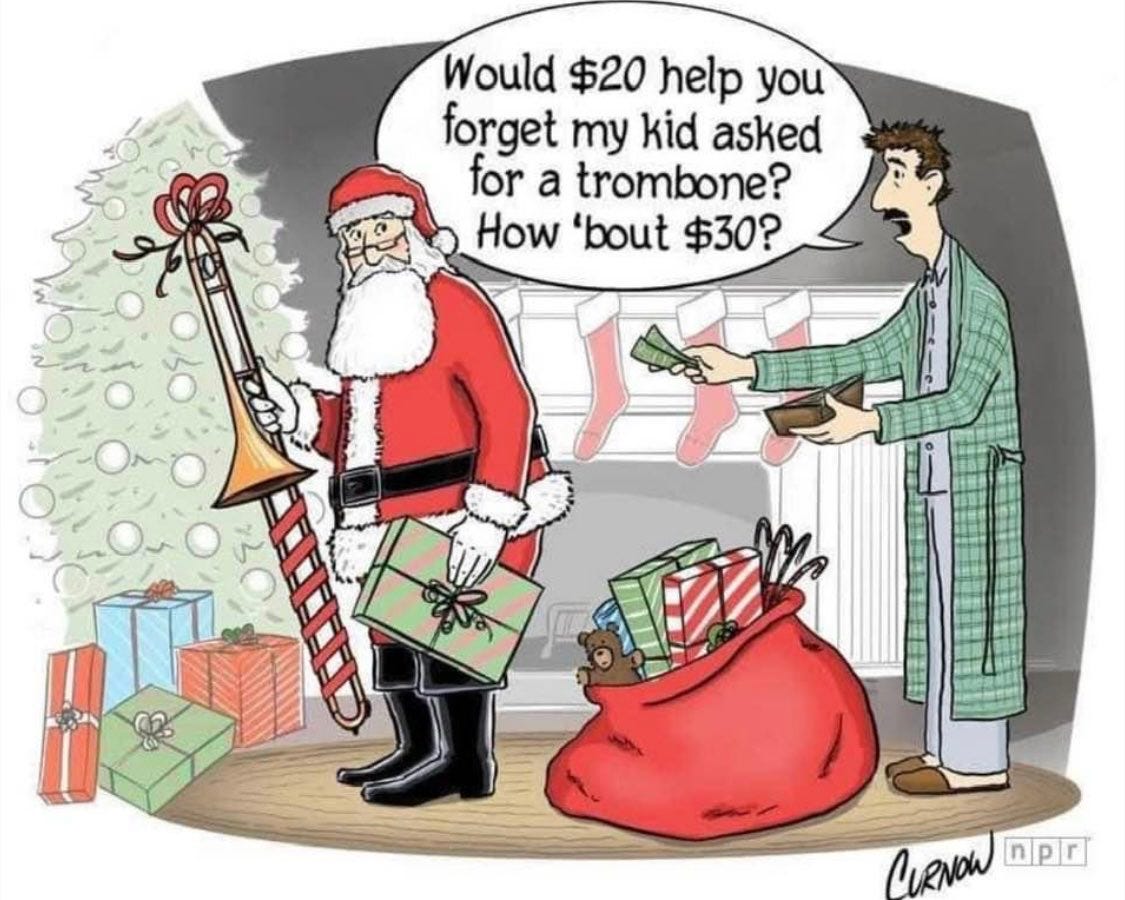
These are not elegant jokes. But they are part of the culture.
There is also a reason so many of the jokes are about employability. Horn players and singers often hit an economic ceiling as sidemen, and trombonists have traditionally been nearest the floor. Almost every jazz gig begins with a trombone joke. One from the pager era asked: What is a trombone player with a pager? An optimist!
Still, the story of the instrument kept moving. Once the trombone had secured its place in the orchestra through Beethoven and the great classical and Romantic composers, it was ready for another reinvention. Then jazz arrived and changed everything.
In New Orleans, the trombone was not backline. It was frontline. Trumpet, clarinet, trombone—three voices in conversation. Kid Ory gave it swagger and commentary. The instrument became less ceremonial and more human.
Which leads to one of my favorite lines: if Jimi Hendrix had been from New Orleans, he would have played trombone.
He was from Seattle, of course. But the point holds.
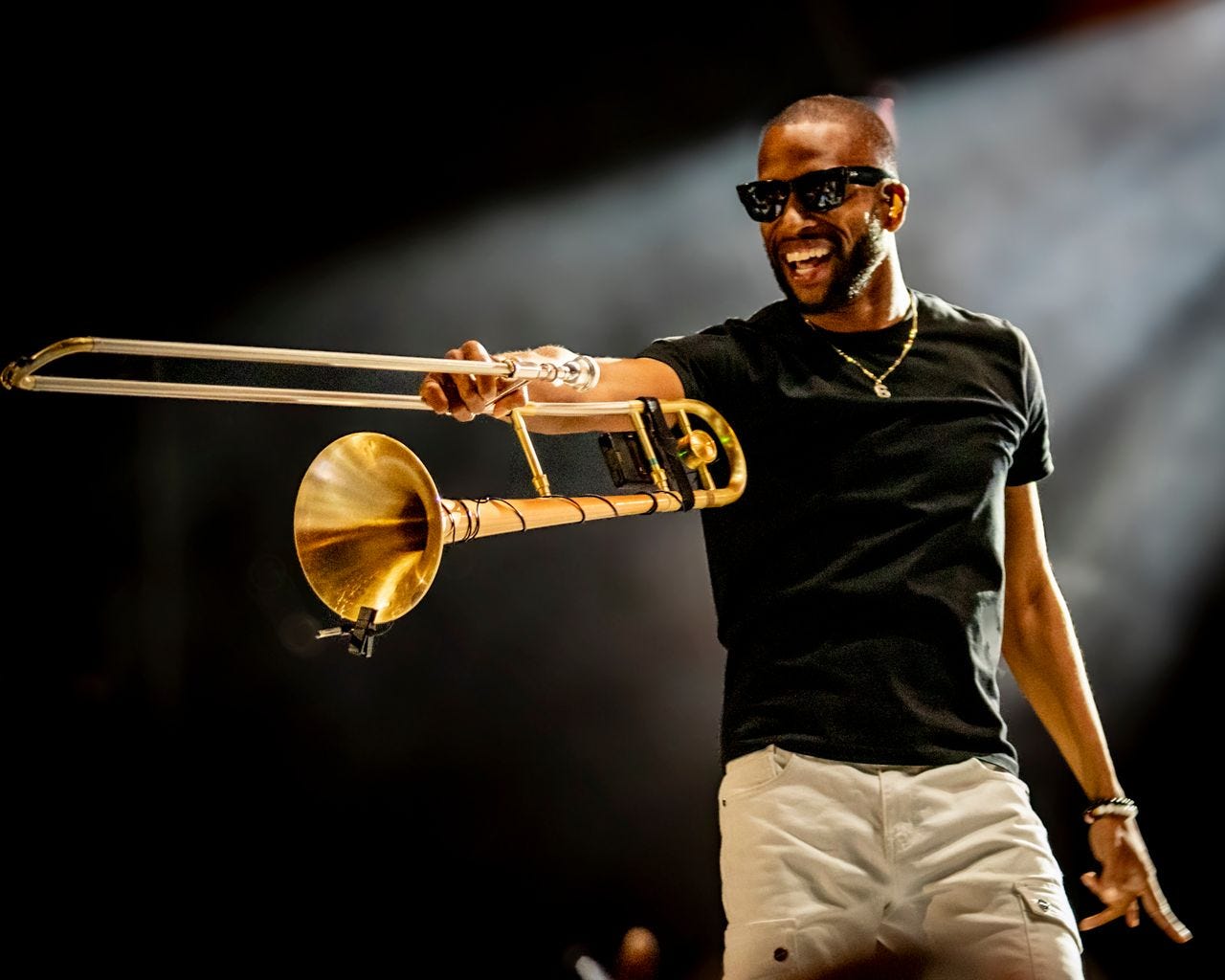
And the New Orleans line did not end with Kid Ory. Trombone Shorty has carried that same spirit forward—part brass-band showman, part serious musician, entirely a son of the city. He reminds you that the trombone in New Orleans is not a museum piece. It is still alive, still streetwise, still joyful, and still capable of leading the band as well as commenting on it.
Swing revealed something else: the trombone could sing.
Tommy Dorsey’s legato influenced Frank Sinatra. Jack Teagarden made it conversational. The instrument could be lyrical, intimate, and expressive.
Glenn Miller showed another side of the instrument’s importance. He did not simply feature the trombone—he built a sound around it. His signature voicing, with clarinet over trombones, made it central to one of the most recognizable sounds in American music.
Then came bebop, with its fast tempos, sharp turns, and rapid chord changes, and many thought the trombone had reached its limit.
J.J. Johnson proved otherwise.
His articulation was so clean and his phrasing so precise that listeners assumed they must be hearing a valve trombone. They were not. They were hearing a master who had solved the problem from within.
Every time someone thinks the instrument has gone as far as it can go, someone pushes it further. The story of the trombone after bebop is full of players who expanded it without losing its humanity.
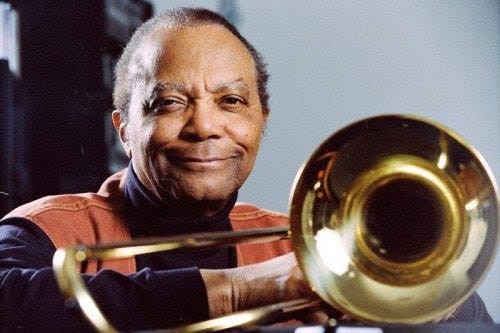
One of my own heroes was Wayne Henderson of the Jazz Crusaders. Wayne was from Houston, Texas, and that sensibility showed. The group played straight-ahead jazz with a Southern feel and a deep groove that opened naturally into funk. Henderson did not need to overpower the instrument to make his point. He played with clarity, soul, and purpose.
I studied with David Bean of the Houston Symphony, who had also toured with Woody Herman. He taught me to play like a classical musician—and to swing behind the beat. Master the instrument, then you can play anything.
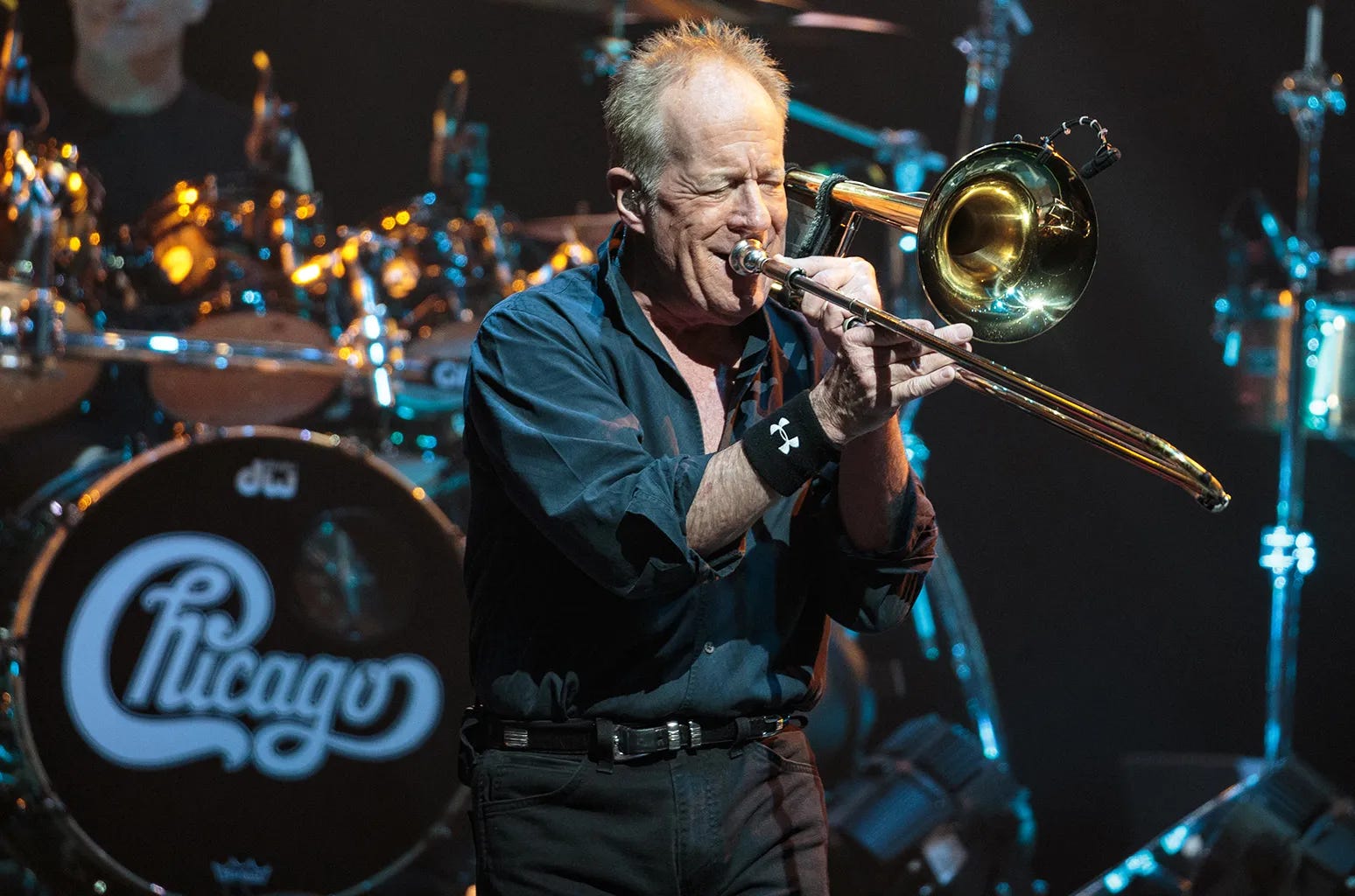
You hear that same principle in classically trained James Pankow, the musical genius behind Chicago. And beyond the famous schools, styles, and turning points, the instrument’s history is also a parade of unforgettable personalities.
Arthur Pryor astonished German musicians so completely that they wanted to dismantle his horn and search for a hidden mechanical trick. Carl Fontana, one of the great postwar jazz trombone virtuosos, played with such ease that colleagues marveled at him, even as he chewed gum through difficult solos.
Frank Rosolino, the brilliant and famously irreverent West Coast jazz trombonist, once sat in an airport coffee shop plagued by flies and reportedly asked the waitress for “a bowl of those flies, please.”
Willie Colón made the instrument urban and defiant in salsa. Fred Wesley made it punch and groove in funk. Steve Turre, equally at home on trombone and conch shells, carried that spirit into jazz and into the Saturday Night Live band. Rico Rodriguez helped give ska its soul. Others—Melba Liston, Abbie Conant, Slide Hampton, Urbie Green, Christian Lindberg, Joe Alessi—expanded the instrument’s language in still other directions.
The trombone attracts originals.
And still the jokes endure. The slide invites them. The sound invites them. The players invite them.
But here is the odd thing: trombonists often turn out to be among the most organized and successful people off the bandstand.
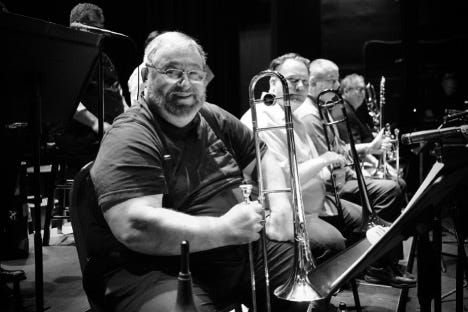
I once played in a group called Chairmen of the Bone—eight trombonists, half CEOs or chairmen, half top professional players. That combination felt exactly right.
Eight trombones, fully exposed, is a kind of truth serum. No hiding. Just precision, blend, timing, and musical intelligence.
And humility. Always humility.
Still, for all the jokes, there is a reason people stay with the instrument.
You don’t just play a trombone. You travel to the note. Every phrase carries motion, intention, and risk.
That has remained true for me—from the Village Vanguard to Napa Valley.
And one of my greatest thrills came in a cathedral in Hollywood, playing Christmas music with more than thirty trombonists, arranged and conducted by legendary studio trombonist Bill Reichenbach, for a benefit supporting musicians in need of healthcare.
In that setting, the old phrase “voice of God” does not feel exaggerated. The sound rises, fills the space, and moves air, stone, and people. It has the character of chant—solemn, human, and timeless.
Which may be the final truth.
The trombone is ridiculous right up until it is sublime.
Sometimes both at once.
Roswell Rudd said it best: you blow in one end, and it disrupts the cosmos.
Comic, yes.
But also true.
Pull. Push. Slide. Find the note.
And try not to hit the saxophone player.
Next Week
How Do They Know?
They Secret Language of Jazz
* * *
Ted Hall is a Senior Partner Emeritus at McKinsey & Company and a founder of the McKinsey Global Institute. He writes about economics, incentives, and how complex systems shape real-world outcomes. A “sometimes” trombonist, he began playing piano at age five and is a product of the acclaimed music program at La Porte High School in Texas. He has performed on trombone in orchestral, Dixieland, small jazz ensemble, and big band settings from New York to San Francisco, where he co-founded Monarch Records, an independent jazz record label. He still performs.
My tuba bucket list is to play in a Banda ensemble, a New Orleans band and something Balkan.
Thanks for starting my Sunday off right—now time to play some Dirty Dozen Brass Band on the box. On my to-do list is to regain my skills as a tuba player. And reading your piece, I remembered that last night I had a dream that involved owning a tuba mouthpiece as a first step to recreating my embrace.
In the same dream, I couldn’t get a sound out of a French horn mouthpiece. And I found a stream replete with spawning steelhead. What does it all mean, Dr. Hall?